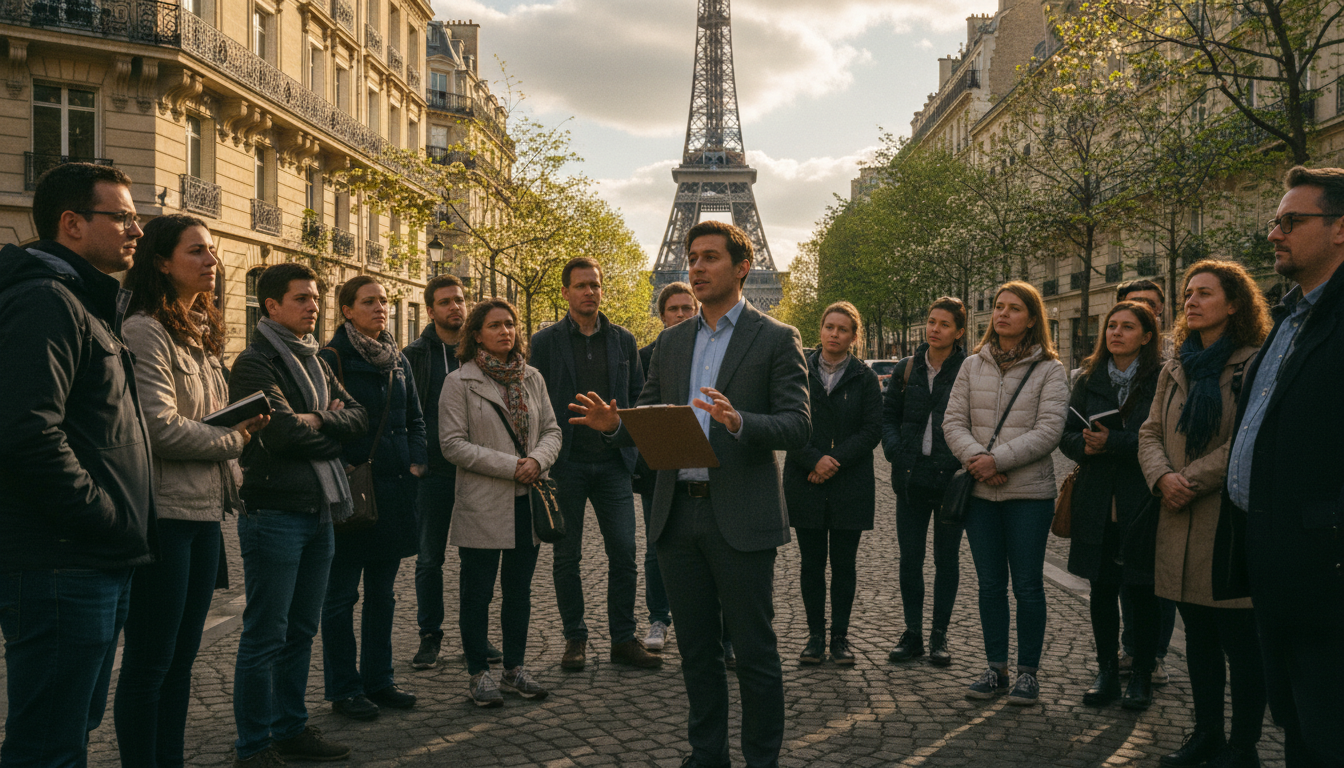
Imagine the Eiffel Tower, Notre-Dame, and the Louvre sharing secrets not found in guidebooks. The City of Light has a 2,000-year history, ready to enrich your visit. Guided history tours paris reveal stories missed by solo explorers.
Professional paris history walking tours make famous sites meaningful. You’ll learn how this ancient city grew into a cultural leader. These tours connect art, politics, and daily life through the ages.
Paris Walks, started in 1994, offers expert-led paris history tours with native English speakers. These two-hour walks are praised by Fodor’s, Rick Steves’, and Lonely Planet. Context Travel leads small groups (max 10) with historians and art historians, giving you skip-the-line access.
Whether you’re new to Paris or returning, historical landmarks paris come to life with expert guides. From World War II sites to medieval churches, cultural heritage tours france are a responsible way to see history.
Key Takeaways
- Professional guided tours share stories and context missed by solo visits at famous sites
- Scholar-led small groups offer close access with historians and art historians as your expert history guides paris
- Two-hour walks cover 2,000 years of history, from Celtic settlement to modern culture
- Skip-the-line access and sustainable tourism preserve the real experience while saving time
- Specialized themes include ancient ruins, World War II sites, medieval architecture, and revolutionary streets
- Recommended companies like Paris Walks and Context Travel are praised by major travel guides
Ancient and Medieval History Walking Tours
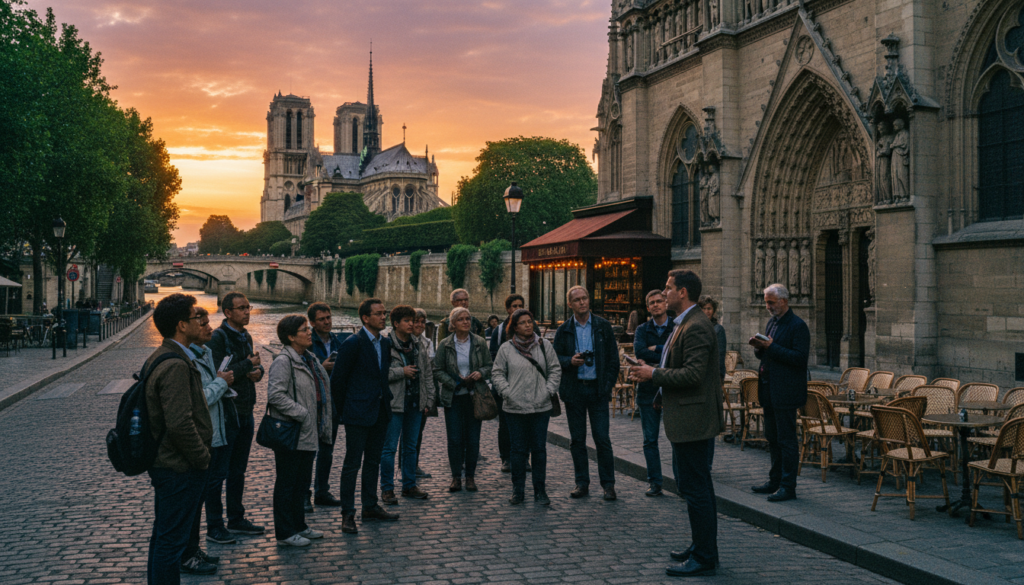
Your journey into Parisian history starts on an island in the Seine. Here, Celts, Romans, and medieval kings left their mark in stone. Paris has over 2,000 years of history, starting with the Celts and Romans, and growing in the Middle Ages. These ancient and medieval history walking tours uncover ancient Paris historical sites that show the city’s early beginnings.
Guided walks by experts bring the past to life. Context Travel offers history-focused tours that explore medieval Paris. Paris Walks provides historical walking tours with guides who know the city’s ancient and medieval heritage well.
Discovering Roman Lutèce Through Ancient Ruins
The roman lutèce and arènes de lutèce guided walk takes you back nearly 2,000 years. Paris was then a modest Roman settlement on the Left Bank. Your guide will show you the Arènes de Lutèce, a well-preserved Roman amphitheater.
This amphitheater dates to the 1st century AD. It was used for gladiatorial contests and theatrical performances. The tour also explores archaeological evidence of Roman occupation in the Latin Quarter.
Medieval Power Center on Île de la Cité
The medieval île de la cité and notre-dame history tour shows how this island became medieval Paris’s heart. You’ll learn about Notre-Dame Cathedral, a Gothic masterpiece built over 200 years. The notre dame historical tours highlight the cathedral’s flying buttresses and rose windows.
Notre-Dame’s rose windows are among the finest medieval stained glass. The tour covers the cathedral’s role in French history, including its near-destruction during the Revolutionary period. Notre dame history tours also discuss the 2019 fire and ongoing restoration efforts.
These architectural history tours paris reveal Gothic innovations that spread across Europe. Your guide will explain how medieval builders solved engineering challenges, creating structures that have lasted over 800 years.
Gothic Masterpieces of Royal and Revolutionary Paris
The sainte-chapelle and conciergerie gothic heritage walk explores two monuments that show medieval power’s dual nature. Sainte-Chapelle is King Louis IX’s royal chapel, built to house Christ’s Crown of Thorns. The chapel’s 15 windows contain 1,113 scenes from the Old and New Testaments.
The tour continues to the Conciergerie, a former royal palace turned revolutionary prison. Your guide will show you the cells where Marie Antoinette and thousands of others awaited execution. This walk shows how medieval Paris history tours connect religious devotion, royal power, and revolutionary justice.
| Monument | Historical Period | Primary Function | Key Features |
|---|---|---|---|
| Sainte-Chapelle | 1242-1248 | Royal chapel for holy relics | 1,113 stained glass scenes, Gothic architecture |
| Conciergerie | 14th century palace, Revolutionary prison | Royal residence then detention center | Gothic halls, Marie Antoinette’s cell, medieval kitchens |
| Notre-Dame | 1163-1345 | Cathedral and coronation site | Flying buttresses, rose windows, gargoyles |
| Arènes de Lutèce | 1st century AD | Roman amphitheater | 15,000-seat capacity, gladiatorial arena |
Roman Baths and Medieval Treasures
The musée de cluny and roman baths history tour takes you through the National Museum of the Middle Ages. It’s housed partly in Roman thermal baths from the 3rd century. These frigidarium ruins are some of the largest Roman structures in Paris.
Your musée de cluny and roman baths history tour will highlight the famous “Lady and the Unicorn” tapestries. These six wool and silk masterpieces represent the five senses and a mysterious sixth panel. The museum has over 23,000 artifacts showing daily life in medieval Paris.
These medieval paris tours with scholar guides show how Roman urban planning influenced medieval development. You’ll see how ancient baths were used in medieval buildings and how the city grew from its Roman foundations. This tour is among the most comprehensive ancient and medieval history walking tours in the city.
History Tours in Paris Covering the French Revolution
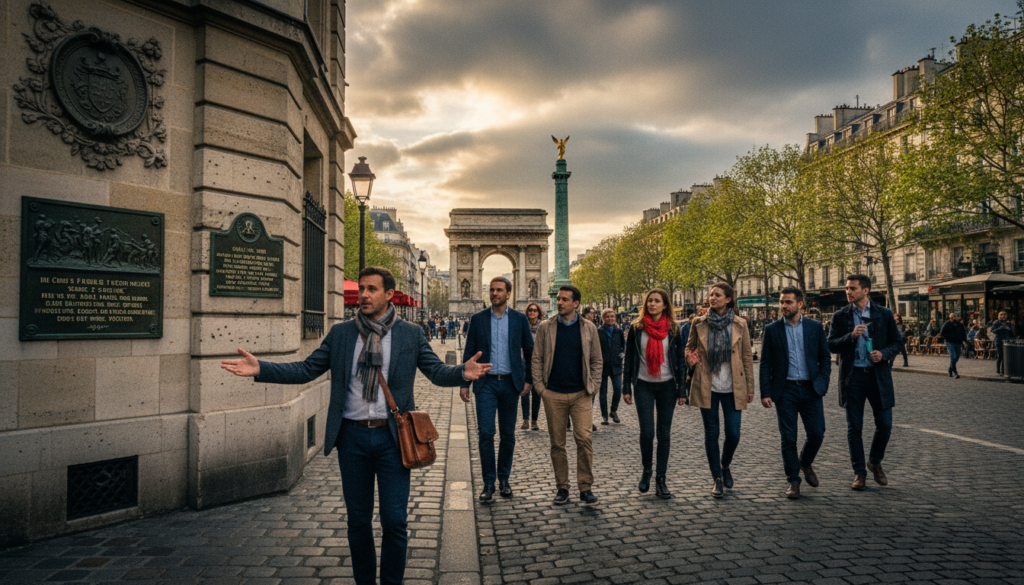
History tours in Paris take you to the places where the French Revolution began. You’ll see where the ideas of liberty, equality, and fraternity were born. These walks connect you to the events of 1789-1799 that changed France and the world.
Expert historians lead you through sites where people challenged the monarchy. You’ll see how they reshaped human rights. It’s a journey through the tumultuous events of the time.
These tours show you the reasons behind the revolution. You’ll learn about the economic and social issues that led to it. Each site adds a new layer to the story.
Revolution Walking Tour from Bastille to Place de la Concorde
The tour starts at the Bastille, where the revolution began. You’ll see the site of the famous storming on July 14, 1789. Today, the Bastille’s outline is marked on the ground.
Next, you’ll walk through the Tuileries Gardens. This was where the royal palace was attacked in 1792. The palace is gone, but its grounds are filled with history.
The tour ends at Place de la Concorde, where many lives were lost. You’ll learn about the key events and figures of the time. Expert historians explain the complex factors behind these events.
Conciergerie and Marie Antoinette Prison History Tour
This tour takes you to the Conciergerie, a Gothic palace turned prison. Over 2,700 prisoners were held here before their executions. It’s a look into the revolution’s darkest days.
You’ll see Marie Antoinette’s cell, where she spent her final days. The simple furnishings and small space show her dramatic fall. Personal items and documents bring her story to life.
The tour also covers the Salle des Girondins, where prisoners awaited their fate. You’ll learn about the revolutionary tribunals and the daily life of prisoners. It’s a deep dive into the Conciergerie’s role in the revolution.
Key features of this tour include:
- Access to Marie Antoinette’s memorial chapel and reconstructed cell
- Original prison architecture including the guard rooms and corridors
- Historical exhibits featuring trial documents and prisoner records
- Expert commentary on the revolutionary tribunal system
- Context about daily life for prisoners awaiting execution
Panthéon and Revolutionary Leaders Heritage Walk
This walk explores the Panthéon, a mausoleum honoring great French citizens. Originally a church, it became a symbol of revolutionary ideals. The entrance reads: “To great men, the grateful homeland.”
You’ll visit the crypts where famous thinkers and leaders are buried. Voltaire and Rousseau, key Enlightenment figures, are honored here. Their ideas on liberty and equality fueled the revolution.
The tour shows how the Panthéon’s purpose has changed over time. It highlights the importance of honoring merit, not nobility. This walk connects philosophical ideas to revolutionary action.
Musée Carnavalet Revolution Gallery Guided Visit
The Musée Carnavalet offers a comprehensive look at the revolution. It houses thousands of artifacts from 1789-1799. This is a key part of any French Revolution tour.
You’ll see original Bastille walls, revolutionary playing cards, and personal items of key figures. The collection includes paintings and propaganda posters. These items show how the revolution affected everyday life.
Significant holdings include:
| Artifact Category | Notable Examples | Historical Significance |
|---|---|---|
| Revolutionary Documents | Declaration of Rights of Man, original manuscripts | Founding texts of modern democracy |
| Personal Items | Marie Antoinette’s prayer book, Robespierre’s possessions | Humanizes historical figures |
| Political Art | David’s revolutionary paintings, propaganda prints | Visual record of ideology and events |
| Architectural Elements | Bastille stones, guillotine blade | Physical remnants of demolished landmarks |
Expert guides explain the significance of each artifact. You’ll see how the revolution changed fashion, furniture, and daily life. The museum brings history to life.
Revolutionary Paris tours at Musée Carnavalet show the revolution’s wide impact. You’ll see how it changed art, fashion, language, and social relationships. The gallery presents revolution as total social transformation, not merely governmental change.
These tours offer a deep understanding of the French Revolution. Each tour offers unique insights into this pivotal period. Together, they show how the revolution shaped modern society.
Napoleonic Era History Tours
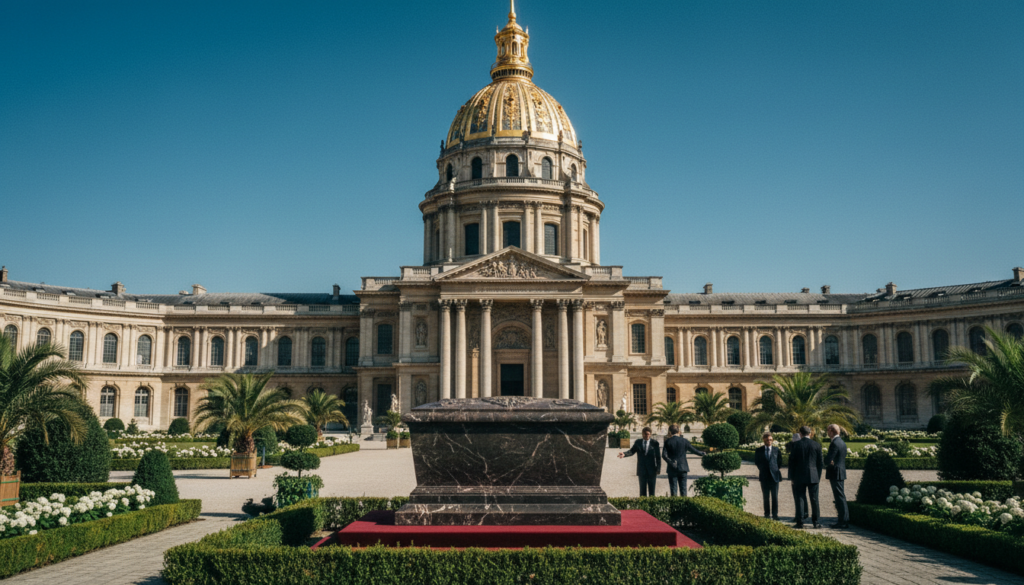
Napoleonic era history tours take you back to the peak of French power under Napoleon Bonaparte. He aimed to make Paris a city fit for his empire. These tours show you around monuments, palaces, and military sites that still show Paris’s grandeur today.
Learn how Napoleon, a Corsican officer, became Emperor of France and changed Paris. He built triumphal arches, victory columns, and monuments to celebrate military victories. Each site tells a story of Napoleon’s vision and how it shaped imperial Paris.
Inside the Military Complex and Imperial Tomb
The les invalides and napoleon’s tomb guided tour takes you to a magnificent military complex. Originally for war veterans, it became Napoleon’s final resting place in 1840. Your guide will show you the Dôme des Invalides, where Napoleon’s remains are kept in a unique way.
Napoleon’s body is in six coffins nested inside each other, in a massive red quartzite sarcophagus. This reflects Napoleon’s grand persona and France’s complex feelings about him. You’ll hear about his military campaigns, from victories in Italy to the disastrous Russian invasion.
The Army Museum (Musée de l’Armée) at Les Invalides has many items from Napoleon’s era. Your tour includes Napoleon’s personal effects, battle flags, and uniforms. You’ll learn how Napoleon’s legal code, the Code Civil, still affects laws worldwide, despite his defeats.
Monuments to Military Glory
The arc de triomphe and napoleonic victories walking tour shows you Napoleon’s iconic monument. The emperor never saw it finished — it was completed after his death. The Arc de Triomphe symbolizes Napoleon’s ambition and French military pride.
Your guide will explain the reliefs on the monument. François Rude’s “Departure of the Volunteers” captures revolutionary spirit. Inside, you’ll see the names of 660 generals on the walls. The tour also talks about how the monument became France’s tomb of the unknown soldier after World War I.
Victory Column and Elegant Square
The vendôme column and place vendôme heritage walk focuses on Napoleon’s 1810 column celebrating the Battle of Austerlitz. Modeled after Trajan’s Column, it was made from 1,250 captured Austrian and Russian cannons. Napoleon’s statue once topped the column, showing his dominance.
You’ll explore the elegant Place Vendôme around the column. Louis XIV’s architect designed it before Napoleon, but he transformed it into a symbol of military glory. Today, the square is known for its luxury and contrast with its martial origins.
Imperial Court Beyond the City
The fontainebleau palace napoleonic day trip from paris takes you to Napoleon’s favorite residence. This château hosted his court and saw key moments of his reign. The tour shows Napoleon’s love for luxury and the personal tragedies that happened there.
Your tour includes the state apartments where Napoleon entertained royalty and diplomats. You’ll see the Throne Room, Napoleon’s private chambers, and the room where he signed his first abdication. The tour ends at the famous horseshoe staircase, where Napoleon said goodbye to his Old Guard before exile.
| Tour Experience | Key Highlights | Historical Significance | Duration |
|---|---|---|---|
| Les Invalides Complex | Six-coffin tomb, Army Museum collections, Dôme architecture | Final resting place showing France’s relationship with Napoleon’s legacy | 2-3 hours |
| Arc de Triomphe Monument | 660 generals’ names, sculptural reliefs, unknown soldier tomb | Symbol of military victories transforming into national memorial | 1.5-2 hours |
| Vendôme Column Square | 44-meter victory column, 1,250 cannon bronze, octagonal plaza | Roman-inspired monument celebrating Austerlitz triumph | 1-1.5 hours |
| Fontainebleau Palace | Abdication room, horseshoe staircase, state apartments, throne room | Personal tragedy and imperial grandeur in Napoleon’s favorite château | Full day (6-8 hours) |
These tours show Napoleon’s lasting impact on Paris’s landscape and architecture. Small-group tours with expert historians offer a deep dive into Napoleon’s reign. You’ll see how Napoleon’s ambitions shaped Paris into a city worthy of an empire, leaving monuments that still define it today.
History Tours in Paris from the Belle Époque
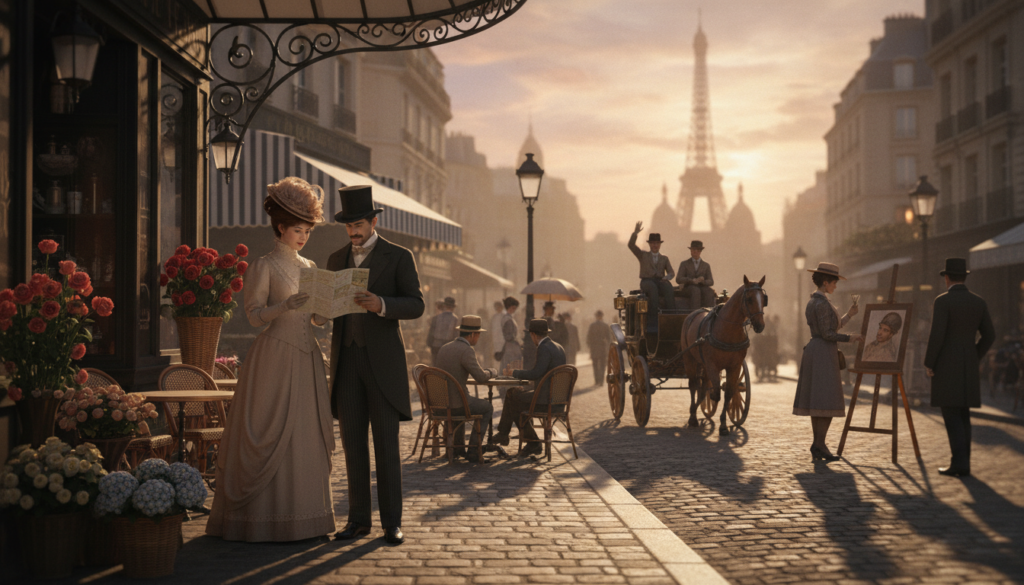
History tours in Paris from the Belle Époque show a time of elegance and creativity before World War I. This period, from 1870 to 1914, saw Paris become the world’s cultural leader. It was a time of artistic innovation, technological progress, and sophisticated living.
These tours reveal how Baron Haussmann’s urban renewal changed the city. The Belle Époque left behind architectural wonders that still amaze us today. You’ll see how attending the opera was a way to show off your status and how artists in bohemian neighborhoods created new art movements.
Exploring Charles Garnier’s Operatic Masterpiece
A tour of the Palais Garnier opera house takes you to one of Paris’s architectural gems. Napoleon III commissioned Charles Garnier to create this masterpiece. You’ll see spaces that defined Parisian high society during the Belle Époque.
The Grand Staircase welcomes you with sweeping double stairways made from multi-colored marble. This dramatic entrance was for elegant arrivals and departures. Aristocrats and wealthy bourgeoisie would parade up these steps, showing off their status.
Inside, you’ll see red velvet seats facing Marc Chagall’s ceiling painting, added in 1964. The Grand Foyer dazzles with gilded mosaics and crystal chandeliers stretching nearly 180 feet. Your guide will tell you how this space was a salon where patrons socialized and made connections.
Many tours also visit Gare Saint-Lazare and Boulevard Haussmann, completing the Art Nouveau architecture experience. You might stop at a traditional brasserie for a drink, experiencing how Parisians of the Belle Époque relaxed after performances.
Twin Palaces of the 1900 World’s Fair
The grand palais and petit palais belle époque walk showcases two exhibition halls built for the 1900 Exposition Universelle. These architectural twins represented France’s confidence and artistic achievements at the turn of the century. The World’s Fair attracted over 50 million visitors, cementing Paris’s reputation as a global cultural leader.
The Grand Palais features a spectacular glass and steel nave that remains one of the world’s largest. This engineering marvel shows the Belle Époque’s embrace of modern materials and construction techniques. Natural light floods the enormous space, creating a revolutionary atmosphere.
Across Avenue Winston Churchill, the Petit Palais houses Paris’s museum of fine arts. You’ll discover collections spanning from antiquity through the early 20th century. The building itself exemplifies Belle Époque design with its ornate façade, semicircular courtyard, and decorative details celebrating art and beauty.
Your guide explains how these structures symbolized Belle Époque optimism about progress and international cooperation. The 1900 Exposition showcased innovations like electricity, cinema, and the newly constructed Métro system that would define the modern era.
Artistic Revolution on the Hilltop
A Montmartre bohemian golden age walking tour takes you through the neighborhood that became the epicenter of avant-garde art. During the Belle Époque, Montmartre’s cheap rents and libertine atmosphere attracted artists who would change art history. You’ll walk streets that Toulouse-Lautrec, Renoir, and Degas once frequented.
The Moulin Rouge cabaret epitomized the era’s celebration of nightlife and entertainment. Your tour explores how this venue and others created thecan-can dance and modern cabaret culture. Toulouse-Lautrec’s posters advertising these establishments became iconic symbols of Belle Époque Paris.
You’ll visit sites where Impressionism, Post-Impressionism, and early modern art were born. Many studios and cafés from this period still exist today. Place du Tertre remains a gathering spot for artists, echoing its Belle Époque role as an open-air studio where creativity flourished.
Your guide shares stories of how Montmartre’s picturesque streets and bohemian lifestyle fostered artistic experimentation. The neighborhood’s distance from conservative downtown Paris allowed artists the freedom to challenge traditional academic painting and develop revolutionary new styles.
Ornate Bridge to Belle Époque Grandeur
The Pont Alexandre III and Exposition Universelle heritage stroll showcases Paris’s most ornate bridge, another 1900 World’s Fair creation. Named to celebrate Franco-Russian friendship, this architectural jewel features elaborate Art Nouveau lamps and sculptures. Cherubs, nymphs, and winged horses in gilt bronze decorate the bridge at each corner.
You’ll learn how the bridge’s single-span arch design was revolutionary for its time. Engineers wanted to avoid obstructing the view between the Invalides and the Grand and Petit Palais. This created a Belle Époque architectural ensemble that represents the era’s confidence and artistic extravagance.
The bridge connects two banks of the Seine, symbolically linking different aspects of Parisian life. On one side, the military grandeur of Les Invalides; on the other, the artistic celebration of the exhibition palaces. Your guide explains how this connection embodied Belle Époque values of progress and beauty.
Walking across Pont Alexandre III offers stunning photo opportunities and historical insights. The decorative details reward close examination, from the elaborate lamp posts to the golden statues representing Fame, Science, Art, and Commerce. This stroll captures how Belle Époque Paris celebrated both aesthetic beauty and modern achievement.
| Tour Experience | Historical Focus | Key Highlights | Best For |
|---|---|---|---|
| Opera House Tour | Haussmann’s urban renewal and high society culture | Grand Staircase, auditorium, Grand Foyer, Art Nouveau architecture | Architecture enthusiasts and opera lovers |
| Grand and Petit Palais Walk | 1900 World’s Fair and international exhibitions | Glass and steel nave, museum collections, Belle Époque engineering | Art and technology history fans |
| Montmartre Bohemian Tour | Avant-garde art movements and cabaret culture | Moulin Rouge, artist studios, Impressionist sites, Place du Tertre | Art history buffs and nightlife culture explorers |
| Pont Alexandre III Stroll | Franco-Russian relations and Exposition Universelle | Ornate sculptures, Art Nouveau lamps, architectural ensemble views | Photography enthusiasts and romantic walkers |
These Belle Époque tours reveal how Paris transformed into a modern metropolis while celebrating beauty and culture. You’ll understand why this era remains so captivating, representing a moment when art, architecture, and daily life achieved remarkable sophistication. The physical legacy of the Beautiful Era continues to define Paris’s identity as a city where elegance and innovation coexist.
World War History Tours
World war history tours in Paris show how the city was shaped by both wars. In World War I, Paris celebrated the arrival of allied soldiers. But in World War II, it faced Nazi occupation. These tours highlight the bravery and moral dilemmas of that time.
Paris was key in both wars. Guided tours help you see the city’s transformation and the memorials left behind. You’ll learn about the struggles and sacrifices made by many.
Celebrating African American Heroes on the Western Front
The Harlem Hellfighters and World War I Paris Heritage Walk tells a forgotten story. The 369th Infantry Regiment, an African American unit from New York, fought bravely. They were welcomed in Paris, despite facing racism back home.
Visiting sites from the American Expeditionary Forces in Paris, you’ll learn about the 369th’s heroism. They served longer in combat than any other American unit and earned French honors.
This tour also explores how World War I changed French society. You’ll see memorials to the 1.4 million French soldiers who died. And you’ll learn about the 1918 armistice that ended the war.
Understanding Nazi Occupation and Freedom’s Return
The World War II Occupation and Liberation Walking Tour covers Paris’s darkest time from 1940 to 1944. It shows how the German occupation changed life and sparked resistance.
You’ll see how Parisians lived under Nazi rule, with food rationing and curfews. Your guide will share stories of passive and active resistance, from underground newspapers to sabotage.
The tour also covers the 1944 liberation of Paris. You’ll visit the Hôtel Meurice, where General Dietrich von Choltitz refused to destroy the city.
These tours delve into the complex moral questions of survival and heroism during the occupation. You’ll understand how ordinary people faced extraordinary challenges.
Confronting Holocaust History at Europe’s Largest Memorial
The Mémorial de la Shoah guided history visit takes you to Europe’s largest Holocaust documentation center. It confronts the systematic persecution that took 76,000 Jewish lives from France.
You’ll see the Wall of Names with victims’ identities, including 11,000 children who never returned. Exhibitions reveal the Vichy regime’s role in deportations and separating families.
Your guide will share stories of survivors and those who risked their lives to save others. The memorial includes a tomb of an unknown Jewish martyr and ashes from extermination camps.
This tour provides insight into antisemitism and genocide. You’ll leave with a deeper appreciation for remembrance and fighting against hatred.
Honoring 200,000 Deportees in a Sacred Space
The Mémorial des Martyrs de la Déportation tour takes you to a memorial on the Île de la Cité. Designed by Georges-Henri Pingusson, it honors the 200,000 people deported from Vichy France to Nazi camps.
You’ll explore a crypt-like space that captures the horror of deportation. The narrow passages and restricted views create a deeply emotional experience.
The memorial walls display 200,000 illuminated crystals, each for a deported person. Your guide will explain how this design turns statistics into human lives lost.
This tour encourages reflection on French actions during the occupation. It helps you understand the importance of confronting painful histories and why remembering these atrocities is crucial today.
World war history tours offer essential perspectives on modern France. Context Travel provides guided experiences that connect historical events to today’s lessons on courage, moral complexity, and remembrance.
History Tours in Paris by Neighbourhood
Walking through Paris’s districts reveals the city’s rich history. Each area has its own story, shaped by different communities over time. History tours in Paris by neighbourhood let you see how architecture, culture, and social movements have defined these areas.
These tours take you off the beaten path. You’ll see streets where locals lived through big changes. Each district has its own vibe, from medieval alleys to bohemian hillsides. Groups like Paris Walks and Context Travel offer deep dives into these areas, uncovering stories missed by general tours.
Medieval Streets and Jewish Heritage in Le Marais
The Le Marais medieval and jewish quarter history walk takes you through the 3rd and 4th arrondissements. You’ll see narrow streets that survived a 19th-century redesign. The area was once farmland, then became an aristocratic quarter in the 1600s.
Your guide will talk about Renaissance hôtels particuliers, grand townhouses for nobility. Place des Vosges, the oldest planned square in Paris, shows elegant symmetry from 1612. Efforts saved the district from decline in the 19th century.
The tour highlights the Marais as Paris’s historic Jewish quarter. It was home to Ashkenazi and Sephardic Jews, despite persecution. You’ll see synagogues, kosher bakeries, and memorials, including the Vel d’Hiv roundup of 1942.
Today, the marais district historical tour also shows the area’s LGBTQ+ culture and fashion. This mix of histories—medieval, aristocratic, Jewish, and modern—makes the Marais a unique part of Paris.
Academic Tradition in the Latin Quarter
The latin quarter sorbonne and intellectual heritage tour takes you to the Left Bank’s heart for 800 years. It got its name from the medieval University of Paris, where Latin was key. Students and philosophers have debated here since the Middle Ages.
You’ll visit the Sorbonne’s historic buildings, where big ideas in theology, philosophy, and law shaped Europe. This place influenced everything from medieval scholasticism to modern education. The architecture tells stories of academic greatness over centuries.
The latin quarter history walks include the Panthéon, honoring France’s greatest minds. You’ll also see Shakespeare and Company bookstore, a hub for Lost Generation writers in the 1920s. The shop still attracts literary fans today.
Historic cafés were outdoor classrooms for existentialist philosophers like Jean-Paul Sartre and Simone de Beauvoir. Your guide will explain how café intellectualism defined Parisian culture. The latin quarter historical tours show how spaces fostered intellectual movements that changed Western thought.
Existentialist Cafés of Saint-Germain-des-Prés
The saint-germain-des-prés existentialist and literary history walk explores the Left Bank’s sophisticated neighborhood. It became known for existentialism, jazz, and intellectual ferment after World War II. You’ll see where philosophy and everyday life merged uniquely in Paris.
Visits include Café de Flore and Les Deux Magots, where Sartre, de Beauvoir, and Albert Camus debated. These cafés were more than meeting spots; they were offices, salons, and stages for intellectual performances. They still operate today, keeping their historic atmosphere.
Jazz clubs hosted American musicians fleeing segregation, creating a cross-cultural exchange. This neighborhood represented a Parisian ideal where art, politics, and daily life blended seamlessly.
The tour also covers the area’s early history as a center of religious learning. The Abbey of Saint-Germain-des-Prés, founded in the 6th century, played a key role. The district became fashionable for artists and writers in the 18th century, setting a pattern for the existentialist era.
Artistic Revolution on Montmartre’s Hill
The montmartre art revolution and village history tour explores the hilltop neighborhood’s transformation. It was once a rural village, then a bohemian artist colony, and now a tourist spot. You’ll walk cobblestone streets where revolutionary art movements were born.
Place du Tertre is where artists still set up easels, just as they have for over a century. Streets where Pablo Picasso, Amedeo Modigliani, and Vincent van Gogh lived and worked are part of the tour. The Bateau-Lavoir studio building was the birthplace of Cubism, changing art forever.
The tour connects the Paris Commune uprising of 1871 to Montmartre’s artistic rebellions. You’ll see how working-class residents and starving artists shared spaces and ideals.
Sacré-Cœur Basilica dominates the skyline, but your guide reveals its role as a political statement after the Commune’s defeat. The gleaming white church contrasts with the revolutionary neighborhood below. Today, Montmartre balances its artistic heritage with modern tourism, creating tensions and opportunities.
These neighborhood-focused tours show how different communities shaped Paris’s identity. Walking through distinct quarters reveals social history, architectural evolution, and cultural significance. Each district offers unique perspectives on Paris’s story, making sightseeing meaningful.
Underground and Hidden History Experiences
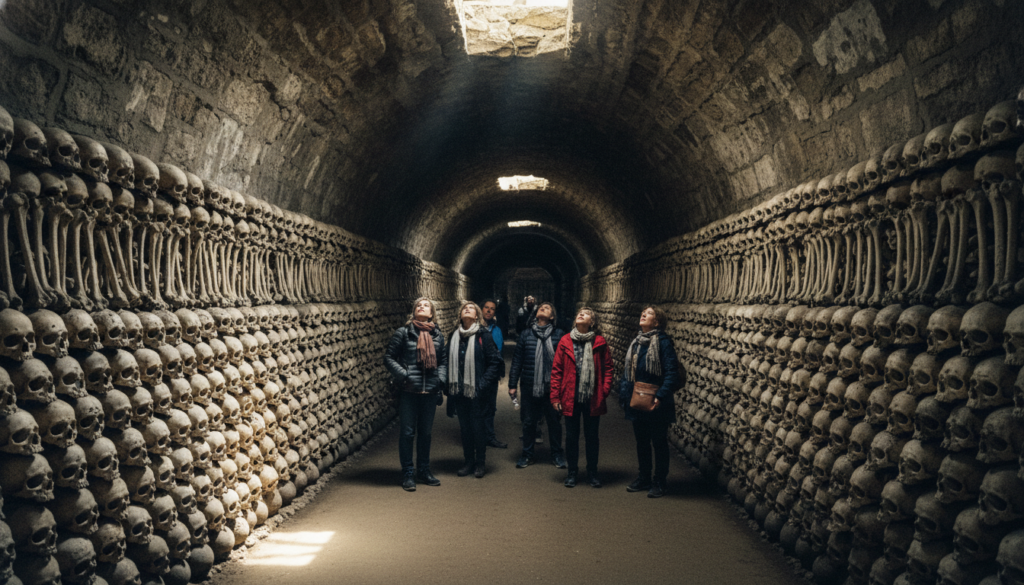
Paris’s hidden history tours offer a unique look at the city’s past. They reveal engineering marvels and the resting places of famous figures. These tours take you to places where Paris’s growth and challenges are told through creative solutions.
The underground world of Paris is vast and fascinating. It includes tunnels filled with bones and advanced sewer systems. These spaces show how Paris grew while keeping its history alive.
Descending into the Empire of the Dead
A tour of the Paris Catacombs takes you 20 meters below street level. Here, subterranean ossuaries hold about six million Parisian remains. The tunnels were once limestone quarries that became a solution to overcrowded cemeteries.
Your guide will explain how Paris’s limestone built the city. The quarrying created tunnels that needed support systems to prevent collapses. Engineers developed systems still seen today.
The Catacombs are filled with philosophical inscriptions. Latin phrases and French poetry reflect on life’s brevity. These passages create an atmosphere unlike any other historical site in the city.
Explorers called cataphiles secretly explore the Catacombs. World War II fighters also used these tunnels. Your guide will share stories of these hidden explorers and their history.
Engineering Marvel Beneath Your Feet
The Sewer Museum tour explores Paris’s 2,400-kilometer sewer system. Developed during the Second Empire, it replaced medieval open sewers. You’ll learn how engineers created a system that parallels every street above.
This tour shows Victorian-era engineering that helped Paris grow. You’ll see original equipment and learn about wastewater treatment. Victor Hugo wrote about these tunnels in Les Misérables.
The Sewer Museum tour connects infrastructure to health improvements. Clean water and waste removal extended lifespans. Your guide will explain how these systems support millions daily.
Glass-Roofed Shopping Galleries
A tour of Paris’s passages couverts takes you through elegant shopping galleries. You’ll see Galerie Vivienne with its mosaic floors and neoclassical decorations. These galleries were cutting-edge commercial designs.
Passage des Panoramas is Paris’s oldest surviving covered arcade. Your guide will talk about its influence on later designs. These passages offered sheltered spaces for shopping and socializing.
The tour includes Passage Jouffroy with its unique shops and atmosphere. You’ll learn how electric lighting changed these spaces. Your guide will share stories of boutiques, cafes, and theaters.
Final Resting Place of Legends
The Père Lachaise Cemetery tour is a journey through French cultural history. You’ll see graves of artists, writers, musicians, and thinkers. This five-star experience is a must-see.
Oscar Wilde’s tomb is famous for lipstick kisses from fans. Chopin’s heart was sent to Warsaw, but his body is here. Edith Piaf’s grave is a site for her devoted fans.
The tour includes Jim Morrison’s grave, a pilgrimage site for music fans. You’ll see graves of Gertrude Stein, Marcel Proust, and Molière. Your guide will bring these legends to life.
The cemetery is also significant for its historical events. You’ll see the Mur des Fédérés and the graves of Héloïse and Abélard. Even Antoine-Augustin Parmentier, who popularized potatoes in France, is recognized here.
| Underground Experience | Historical Period | Primary Focus | Typical Duration |
|---|---|---|---|
| Paris Catacombs | Late 18th-19th Century | Ossuary and limestone quarries | 90 minutes |
| Sewer Museum | 19th Century-Present | Engineering and public health | 75 minutes |
| Covered Arcades | Early 19th Century | Commercial architecture | 2 hours |
| Père Lachaise Cemetery | 1804-Present | Cultural figures and monuments | 2-3 hours |
These tours show Paris’s hidden history is just as fascinating as its famous landmarks. You’ll see how engineering, innovation, and cultural memory shaped the city. These experiences offer a unique perspective on Paris’s development.
History Tours in Paris for Families and Students
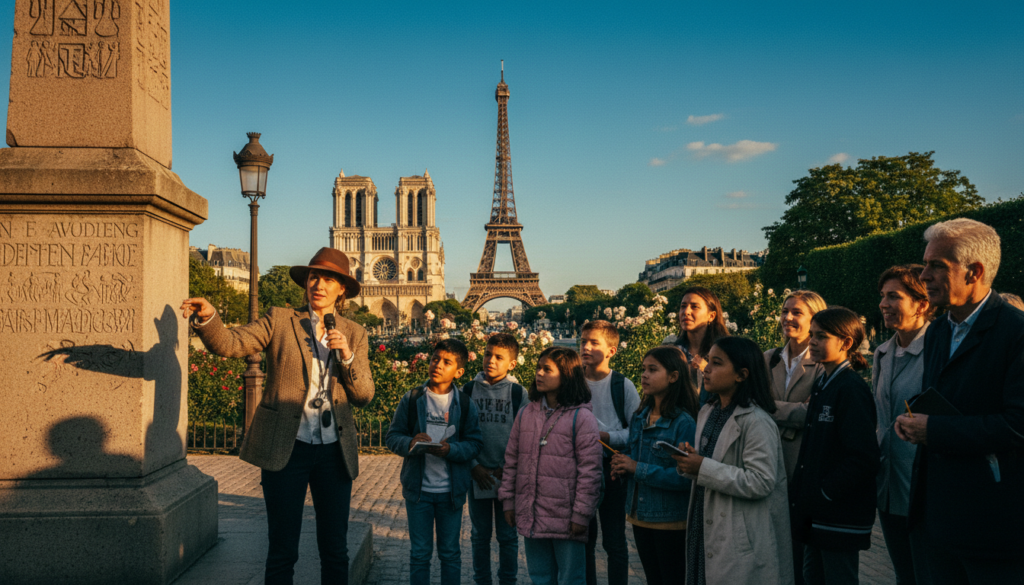
History tours in Paris for families and students make the city’s past fun for kids and teens. These tours know that young people learn differently than adults. They mix real history with fun activities to keep everyone interested.
Paris has many tours for different ages. Context Travel offers interactive museum tours for kids and families. The city’s history, from old buildings to revolution sites, offers lots of ways to learn.
Kid-Friendly Interactive History Treasure Hunt
A kid-friendly history treasure hunt is a game for kids 6 to 12. They search for details, solve riddles, and complete challenges. It’s a fun way to learn French history.
Kids might find gargoyles on buildings or solve symbols in the Marais. Some hunts follow clues about Marie Antoinette or Roman Lutèce. Guides use stories and activities to keep kids focused.
These tours last two hours with breaks. Parents like how kids are actively learning instead of just listening. The way kids learn is matched to how they naturally explore.
Student Group History Tour with Academic Guide
A history tour for student groups is for middle school to university students. Guides with history knowledge adjust the tour to fit what you’re studying. They connect classroom learning to real sites.
Guides lead discussions that make you think about history. Tours can focus on your classroom topics. Some include visits to archives or libraries.
Universities and schools can book private tours. Guides link past events to today’s issues. Some tours have assignments like sketching or interviews.
Family Revolution and Royal Paris Walking Tour
A family tour on the French Revolution and royal Paris is for kids 8 to 16. It uses stories about famous people like Louis XVI and Marie Antoinette. This makes history feel real for kids.
Guides share fun facts for kids while keeping adults interested. You might learn about what kids ate or played in different times. This keeps everyone engaged.
The tour includes breaks at parks or cafés. Visual aids and stories make the walk fun. Kids can ask questions and share their thoughts.
Teen-Focused Paris Through the Ages Guided Walk
A teen-focused tour is for 13 to 18-year-olds. It’s designed to keep teens interested with discussions on complex topics. Teens learn to think critically about history.
Guides use modern references to make history relatable. Discussions might include how social media would change history or the ethics of revolution. Teens are treated as capable thinkers.
Topics include fashion, music, and technology history. Guides are trained to work with teens and use humor. Teens can share ideas and debate history.
| Tour Type | Age Range | Key Features | Duration | Learning Approach |
|---|---|---|---|---|
| Interactive History Treasure Hunt | 6-12 years | Game-based, physical challenges, riddles, scavenger format | 2 hours | Active participation and discovery |
| Student Group Academic Tour | 12-22 years | Curriculum-aligned, discussion-based, customizable themes | 2-3 hours | Critical thinking and analysis |
| Family Revolution Tour | 8-16 years | Character-driven stories, mixed-age content, visual aids | 2.5 hours | Narrative storytelling with breaks |
| Teen Through the Ages Walk | 13-18 years | Moral complexity, contemporary references, debate format | 2.5 hours | Discussion and critical engagement |
These tours show that learning history for young travelers needs careful planning. Each tour meets the needs of different ages while teaching real history. Families and educators can find the right tour for their group.
Paris is great for educational travel with the right tours. The city’s museums, gardens, and sites can be made fun for kids and teens. Age-appropriate history tours make sure everyone has a meaningful experience in Paris.
How to Choose the Best History Tour in Paris
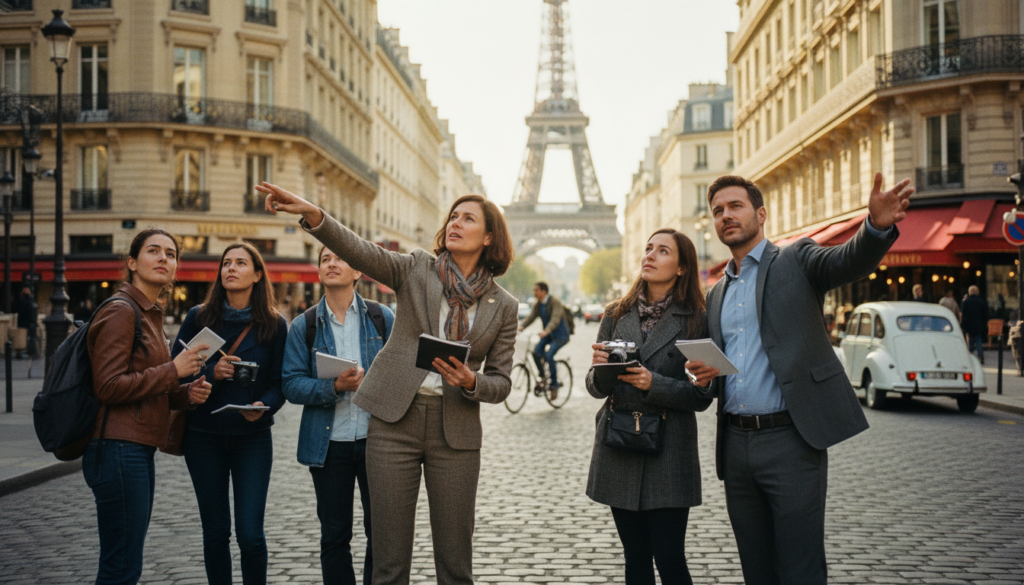
Paris offers hundreds of history tours. Knowing how to pick the right one can make your trip better. The best tour can turn history into real-life experiences. This guide helps you find tours that fit your interests and budget.
Choosing a tour involves looking at several things. You need to check the guide’s qualifications, the tour’s focus, and the logistics. Also, it’s important to find out if the tour is good by checking reviews.
Qualifications That Matter: Academic Historians vs Experienced Guides
Choosing between licensed historian guides and regular tour leaders is key. Historian guides have degrees in history and share their research. They can answer complex questions and offer different views on history.
Context Travel uses PhD historians as guides. They provide in-depth analysis and engage with travelers. This is great for specialized era-specific tours or for those with a deep interest in history.
Paris Walks, founded in 1994, has guides with years of experience. They are knowledgeable and speak excellent French. Even though they may not have history degrees, they have a lot of experience and are well-reviewed.
Your choice depends on your interests and what you want to learn. If you’re into deep history, go for a historian guide. But if you prefer a more general tour, an experienced guide might be better.
The best guide for you isn’t always the most credentialed. It’s the one whose knowledge and teaching style match your interests and learning style.
When looking at guide qualifications, ask specific questions. Find out about their education, specialization, and experience. Good tour operators will give you this information clearly.
Depth vs Breadth: Focused Period Tours or Historical Overviews
Choosing between focused period tours and general historical surveys is important. Each type has its own benefits. Knowing what you want will help you pick the right tour.
Era-specific tours focus on one period, like the French Revolution. They visit sites related to that era and explore its social, political, and cultural context. You’ll learn a lot about that time.
These tours are perfect for history buffs. If you’re interested in Marie Antoinette, for example, a dedicated Revolution tour will give you a deep understanding. Architecture lovers will enjoy focused tours on the Belle Époque.
General history tours cover Paris’s entire history. They’re great for first-time visitors. They help you understand how the city evolved and provide context for exploring on your own.
It’s a good idea to start with a general paris historical landmarks tour. This gives you an overview and helps you decide which eras interest you most. Then, you can dive deeper into those periods.
Consider how long you have in Paris when choosing. If you only have a few days, a general survey is best. But if you have more time, you can explore specific eras in depth.
Practical Factors: Group Dynamics, Time Commitment, and True Cost
Practical considerations like group size, duration, and cost are important. They affect how much you learn and enjoy the tour. Look for tours that offer good value for what you pay.
Group size matters a lot. Context Travel keeps groups small, so everyone can hear and participate. This makes for a more personal and engaging experience. Larger groups can feel impersonal and make it hard to ask questions.
Tour length varies a lot. Walking tours last 2-3 hours, while museum tours take 3-4 hours. Full-day trips to places like Versailles take 6-8 hours. Choose a tour that fits your energy and schedule.
Match the tour length to your stamina and focus. Short walks are good for seeing a lot in a day. Museum tours take more time but offer a deep dive. Full-day trips give a comprehensive experience but take up a whole day.
| Tour Type | Typical Duration | Price Range | Best For |
|---|---|---|---|
| Walking Tours | 2-3 hours | €25-€45 | Neighborhood exploration, general overview |
| Museum Tours | 3-4 hours | €45-€85 | Deep dives into specific collections |
| Day Excursions | 6-8 hours | €85-€180 | Versailles, Fontainebleau, comprehensive experiences |
| Private Tours | Flexible | €300-€600 | Families, customized itineraries, flexible pacing |
Pricing for paris museum history tours varies from €25-€100 per person. This depends on the guide’s expertise, group size, and what’s included. Always check what’s in the base price and what’s extra.
A €35 tour with Louvre admission and skip-the-line is better value than a €25 tour that requires separate tickets and long waits. Remember, time spent waiting is time not spent learning.
Private tours cost €300-€600 for up to six people. They offer flexibility and personalized attention. This is great for families or groups who want a unique experience.
Finding Quality: Navigating Booking Platforms and Reviews
Finding reliable tour operators and specific tours requires careful research. With so many options, it’s important to choose wisely. This ensures you get a good experience and avoid disappointments.
Start by researching companies’ reputations. Use sites like TripAdvisor, Google Reviews, and specialized tour booking sites. Look for specific details in reviews to spot fake ones.
Check reviewer histories when you can. People with many reviews across different services are more trustworthy. Look for patterns in criticism to spot common issues.
You can book directly with tour operators or use platforms like Viator or GetYourGuide. Each method has its own benefits. Direct booking can be cheaper and offer better communication, while platforms provide convenience and unified policies.
Watch for red flags when evaluating tours:
- Vague tour descriptions
- No guide credentials
- Companies without clear contact info
- Prices that seem too good to be true
- Unclear cancellation policies
Make a checklist before booking to ensure you’re choosing quality tours. Confirm the tour language, meeting points, and what’s included. Also, check cancellation policies, especially for paris architecture history tours or outdoor walks.
Ask about accessibility if you have mobility issues. Many sites have stairs or uneven surfaces. Good operators will tell you about these before you go.
Find out if tours run in all weather or have rain alternatives. Walking tours can be tough in the rain, but good operators have plans for bad weather.
The most expensive tour isn’t always the best, and the cheapest option rarely delivers quality. Look for value in what you get for your money.
By carefully evaluating tours, you can find the best ones for your interests and budget. This ensures your investment in how to choose the best history tour in paris is worth it and leaves you with lasting memories.
Final Tips for Getting the Most Out of History Tours in Paris
Planning ahead makes your Paris history tour better. Book early for popular tours like evening Seine cruises and specialty walks. These often sell out quickly. Tours usually last two to four hours, so wear comfy shoes.
Montmartre’s steep, uneven streets can be tough, even for seasoned walkers. Timing is key for a great experience. Morning tours are less crowded and cooler, while sunset walks are magical.
Evening tours, especially at the Eiffel Tower, are stunning. For river cruises, bring a light jacket as the Seine’s breeze can be cool, even in summer.
For a well-rounded day, mix different tours. Try a morning walking or bus tour followed by an evening food walk or river cruise. Guides often speak English, with Spanish, French, and Italian options too. You can find various tour combinations that fit your interests and schedule.
Don’t forget your camera, but also listen to your guide. The best photos come from experiences you fully enjoy. Remember to tip your guide, as their knowledge makes the tour unforgettable. Each tour offers a unique view of Paris, revealing stories you might not find on your own.
FAQ
What are the best history tours in Paris for first-time visitors?
For first-timers, general walking tours are great. They cover Paris’s history from ancient times to today. The Medieval Île de la Cité and Notre-Dame History Tour is a good start.
The Revolution Walking Tour from Bastille to Place de la Concorde is also key. It shows how the French Revolution changed France. Tours like the Latin Quarter Sorbonne and the Le Marais Medieval and Jewish Quarter History Walk are also good. They mix history with practical tips for exploring Paris.
How long do typical Paris history walking tours last?
Most tours last 2 to 3 hours. This gives enough time to see sites, hear stories, and ask questions. Museum tours, like the Musée Carnavalet, last 2-2.5 hours.
Neighborhood tours, like Montmartre, last 2-3 hours. They cover about 2-3 kilometers at a slow pace. Half-day tours, like the Sainte-Chapelle and Conciergerie, last 4-5 hours.
Full-day tours, like the Fontainebleau Palace Napoleonic Day Trip, last 6-8 hours. Choose a tour length that fits your stamina and plans for the day.
Do I need to book Paris history tours in advance or can I join them on arrival?
Booking in advance is best, especially in peak season. Tours like the Paris Catacombs often sell out weeks early. Small-group tours with PhD guides, like those from Context Travel, also book up fast.
Monument tours, like those to Sainte-Chapelle, need booking for skip-the-line access. Some companies offer walk-up spots, but they might be full. Booking early ensures your preferred dates and times.
What’s the difference between licensed historian guides and regular tour guides in Paris?
Licensed historian guides have advanced degrees in history or related fields. They offer deep knowledge and can discuss complex historical topics. Companies like Context Travel employ PhD historians for their tours.
Regular licensed tour guides have official credentials but may not have history degrees. Many experienced guides develop deep knowledge over time. Your choice depends on your interests and what you value more: academic credentials or engaging storytelling.
Are Paris history tours suitable for children and teenagers?
Yes, many tours are designed for younger travelers. Kid-Friendly Interactive History Treasure Hunt tours are great for kids aged 6-12. They make learning fun through games and challenges.
Family tours, like the Revolution and Royal Paris Walking Tours, use stories to engage all ages. Teen-focused tours, like Paris Through the Ages, help teens think critically. Student Group History Tours are also available for educational programs.
What should I wear and bring on a Paris history walking tour?
Wear comfortable shoes and dress in layers for unpredictable weather. Bring a refillable water bottle and a notebook for notes. Your smartphone or camera can capture memories, but try to stay present.
Consider a small bag for your hands and to carry essentials. For church visits, wear modest clothing. Sunglasses and sunscreen are essential in summer, while gloves and hats are needed in winter.
How much do Paris history tours typically cost?
Tour prices vary based on the tour length, guide expertise, and what’s included. Budget-friendly tours cost €15-30 per person for 2 hours. Mid-range tours, like those to Sainte-Chapelle, cost €40-70 per person.
Premium tours, like those from Context Travel, cost €70-100 per person. They offer expert guides and small groups. Private tours for families or small groups cost €300-600 total for 2-3 hours.
Can I take Paris history tours if I have mobility limitations or use a wheelchair?
Accessibility varies among tours due to Paris’s historic infrastructure. Look for specific accessibility information or contact operators directly. Some tours, like the Latin Quarter Sorbonne, are wheelchair accessible.
Monuments like Notre-Dame have limited accessibility. The Louvre Museum History Tours are wheelchair accessible. The Paris Catacombs are not accessible to wheelchair users. Private tours offer more flexibility for mobility-limited travelers.
What’s the best time of year to take history tours in Paris?
Paris history tours operate year-round, each season offering unique advantages and challenges. Spring and fall have mild weather and fewer crowds, making them ideal for walking tours.
Summer offers long daylight hours but brings peak tourist crowds. Winter has smaller groups and lower prices but shorter daylight hours. Shoulder seasons (April-May and September-October) offer pleasant weather and moderate crowds.
Are Paris history tours conducted in English by native English speakers?
Most major Paris tour companies offer tours in fluent English. Look for companies that specifically mention English-speaking guides. Context Travel, Paris Walks, and Fat Tire Tours employ native or fluent English-speaking guides.
Many guides are multilingual French historians who speak excellent English. Check tour descriptions for language information. Private tours offer the most flexibility in language preferences.
Can I customize or combine different Paris history tours to match my specific interests?
Yes, tour customization is widely available, especially through private tours. You can combine elements from different standard tours. Context Travel specializes in creating custom itineraries based on your interests.
Even scheduled group tours can be combined strategically. Private tours offer maximum flexibility for holiday scheduling. Customization costs more but delivers targeted experiences, especially for repeat visitors.
How do I find Paris history tours led by actual historians rather than general tour guides?
Look for companies that emphasize academic expertise in their marketing. Context Travel employs PhD historians as guides. Read guide biographies and reviews to assess their qualifications.
Ask tour operators about guide qualifications when booking. Reputable companies will provide honest answers. Private tours allow you to request specific credentials for your guides.
What’s included in the price of Paris history tours and what requires additional payment?
What’s included varies among tour operators. Most walking tours include guide services only. Monument entry fees are often not included.
Premium tours bundle monument admissions into pricing. Transportation to/from tour meeting points is rarely included. Food and beverages are generally excluded. Gratuities for guides are not included and are at your discretion.
Are there Paris history tours that focus specifically on World War II occupation and the Holocaust?
Yes, several tours address Paris’s World War II occupation, resistance efforts, and Holocaust remembrance. The World War II Occupation and Liberation Walking Tour covers key sites.
These tours explore the complex moral landscape of occupation. The Mémorial de la Shoah Guided History Visit provides Holocaust education. Some tours focus on Jewish history in the Marais district.
How do I find Paris history tours that focus on women’s history or LGBTQ+ heritage?
Specialized tours on women’s history and LGBTQ+ heritage are available. Women’s history tours highlight figures like Blanche of Castile and Marie Curie. LGBTQ+ heritage tours explore Paris’s role in queer history.
These tours visit relevant sites and discuss historical figures. Finding these tours requires research. Contact tour operators directly to arrange custom tours.
How do Paris history tours handle the Notre-Dame Cathedral after the 2019 fire?
Since the 2019 fire, tours have adapted to discuss the cathedral’s history and ongoing restoration. Medieval Île de la Cité and Notre-Dame History Tours focus on the cathedral’s exterior.
Guides explain the fire’s causes and the reconstruction project. Some tours visit nearby viewpoints to see the scaffolding. Tours emphasize the cathedral’s survival and ongoing story.
Can I tip my Paris history tour guide and how much is appropriate?
Tipping tour guides is customary but not obligatory. It’s a way to show appreciation for their service. For scheduled group tours, €5-10 per person is appropriate.
For premium tours, like those from Context Travel, €10-20 per person is suitable. Full-day tours warrant higher tips. Tipping in cash directly to the guide is best.