Every year, over 30 million tourists flock to Paris, dreaming of the Eiffel Tower and the Louvre. But many get lost in the city instead of enjoying it. The key is a good paris tourist map made for travelers.
A good paris sightseeing map helps you grasp the city’s arrondissement system. It shows where landmarks are close together. This way, you can plan walks that link attractions without wasting time.
Experts suggest maps that also show metro stations, water fountains, and restrooms near big sites.
This guide shows you the best mapping strategies for Paris. You’ll learn how to use digital and paper maps, understand the city’s layout, and make your own plans. Whether you’re here for three days or three weeks, knowing your way around Paris makes your trip better.
Key Takeaways
- Paris welcomes over 30 million visitors annually, making advance navigation planning essential for maximizing your trip
- Understanding the arrondissement system helps you quickly identify which districts contain your must-see landmarks
- Comprehensive tourist maps include practical features like transport connections, water fountains, and public facilities near attractions
- Creating walking routes that connect clustered landmarks saves significant time compared to random exploration
- Both digital interactive maps and printable versions serve different purposes during your Paris adventure
- Local-designed maps reveal hidden gems beyond famous monuments for a more authentic experience
Understanding the Layout of Paris by Arrondissement
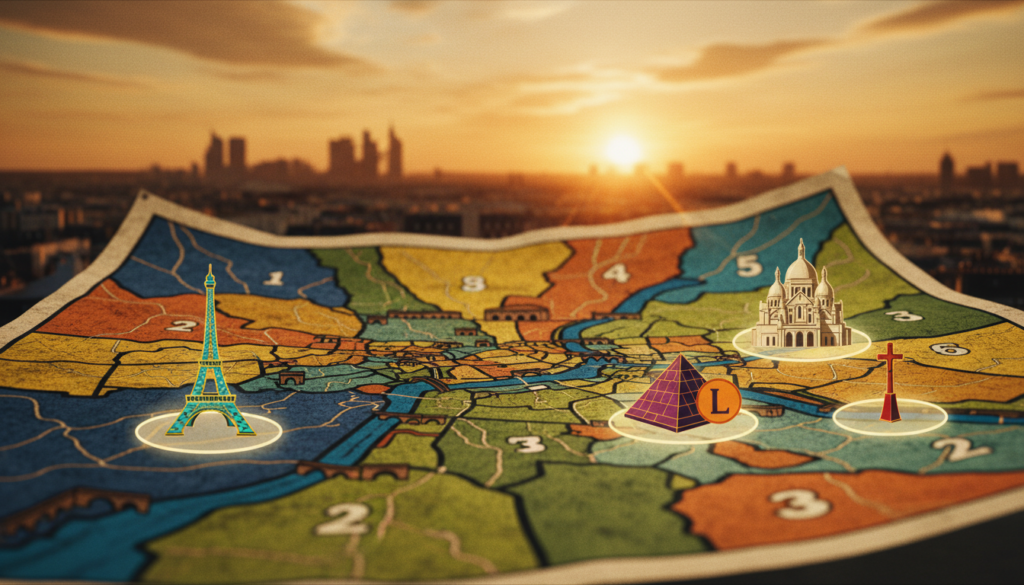
Exploring Paris is easier when you know the arrondissement layout. The city is divided into 20 districts, each with its own charm and landmarks. This system helps you plan your trip and find the best place to stay based on what you want to see.
The districts follow a spiral pattern starting at the historic center. The 1st arrondissement is around the Louvre. Lower-numbered districts are closer to major attractions, making them great for first-time visitors.
The Seine River splits Paris into two areas with different vibes. This natural divide affects your experience and the landmarks you’ll see. Knowing this helps you navigate the city better.
The Seine’s Two Sides: Cultural and Tourist Distinctions
The Right Bank has grand boulevards and luxury shopping. It includes the 1st through 8th arrondissements and parts of the 9th through 12th. You’ll find famous museums like the Louvre here.
The Marais neighborhood on the Right Bank is known for its unique shops and lively atmosphere. It’s pricier but offers a special experience. Here, medieval and modern styles blend together.
The Left Bank is home to intellectuals and artists. It includes the 5th, 6th, 7th, and parts of the 13th through 15th arrondissements. The Latin Quarter and Saint-Germain-des-Prés are here, along with the Eiffel Tower.
The Left Bank has a bohemian feel. It’s filled with universities, bookshops, and cozy bistros. The cultural differences between the Right and Left Banks are significant and have evolved over time.
The Clockwise Spiral Pattern Explained
The spiral system makes it easier to understand distances and plan routes. It starts at the Louvre and spirals outward. Each district is connected in a clockwise pattern.
This pattern means districts with close numbers might not be next to each other. Knowing this helps avoid confusion when traveling between districts.
The system ends at the 20th arrondissement in the northeast. Each rotation moves you farther from the center. Seeing Paris as a spiral helps you understand the layout better.
Location Strategy for Your Stay
Choosing between central and outer arrondissements depends on your priorities. Central areas are close to landmarks but more expensive. Outer areas offer a local feel and are cheaper.
Montmartre is in the 18th arrondissement, but it’s far from other attractions. The 11th arrondissement around Bastille is a good value with easy metro access. The 19th has Buttes-Chaumount park and the trendy Canal Saint-Martin area.
Consider these factors when deciding between central and outer areas:
- Walking vs metro travel: Central areas are better for walking, while outer areas require more public transport
- Budget considerations: Outer areas are 30-50% cheaper for similar accommodations
- Neighborhood atmosphere: Outer areas offer a real local experience away from tourists
- Time efficiency: Central areas save time during short visits
Some areas need extra caution. Gare du Nord has a rough reputation, so avoid staying nearby. A clear map of arrondissement boundaries helps plan efficient routes.
Map of Attractions in Paris Around the Eiffel Tower and Trocadéro
The Eiffel Tower and Trocadéro area in Paris is packed with famous landmarks. This area in the 7th arrondissement is the heart of any eiffel tower location map. You can walk to many attractions in 30-45 minutes. Each place offers a unique view of Paris’s culture and history.
The Seine River splits the district into two parts. The south side has the tower and cultural museums. The north side, Trocadéro, has viewing platforms and museums. Knowing this layout helps you make the most of your visit and get great photos.
The Iron Lady and Her Garden Backdrop
The Eiffel Tower and Champ de Mars are the main attractions in this area. Gustave Eiffel’s tower stands 330 meters tall. You can climb or take elevators to the top.
Booking tickets early saves you from long waits. Paris City Vision suggests booking weeks in advance. This way, you can avoid two-hour wait times and get a smooth entry.
The Champ de Mars gardens stretch behind the tower. They are perfect for picnics and photos, especially at sunset. People enjoy eating and drinking here with the tower as a backdrop.
Getting to the eiffel tower location paris is easy. You can take Metro to Bir-Hakeim or Champ de Mars – Tour Eiffel. Line 6 offers great views of the tower.
The Perfect Viewing Platform Across the Seine
The Palais de Chaillot and Trocadéro Gardens offer the best view of the Eiffel Tower. The Trocadéro plaza is crowded at sunrise and sunset. Everyone wants to take a photo with the tower in the background.
The Palais de Chaillot has three museums. The Cité de l’Architecture et du Patrimoine shows French architecture. The Musée de l’Homme explores human anthropology. The Musée National de la Marine focuses on France’s naval history.
The Trocadéro Gardens have fountains that display water shows. Walking down these gardens takes you to the Pont d’Iéna bridge. This bridge connects to the Eiffel Tower’s base.
Metro Line 6 stops at Trocadéro station. This puts you right at the plaza. You’re also close to the Arc de Triomphe area.
Indigenous Cultures in Modern Architecture
A short walk from the tower is the Musée du Quai Branly. This museum is dedicated to indigenous arts and cultures. Architect Jean Nouvel designed it with a living wall of plants.
The museum has collections from Africa, Asia, Oceania, and the Americas. You can see textiles, sculptures, and musical instruments in well-lit galleries. The outdoor garden has sculptures and offers another view of the Eiffel Tower.
Plan to spend 90 minutes to two hours in the museum. It’s between Alma-Marceau and Bir-Hakeim Metro stations on Line 6.
River Connection and Cruise Departures
The Pont de l’Alma and Seine Riverbanks are more than just crossing points. They are where many Seine river cruises start. The famous Bateaux Mouches boats offer glass-topped views of Paris.
The riverbanks have been turned into walkways called the Berges de Seine. You can walk or bike here, passing under bridges and by houseboats. These paths connect all major attractions without street traffic.
The Alma-Marceau Metro station is near the bridge area. Most visitors walk from the Eiffel Tower in about 10 minutes. The bridge area is magical at night, especially during the tower’s light show.
| Attraction | Recommended Visit Time | Advance Booking | Nearest Metro |
|---|---|---|---|
| Eiffel Tower | 2-3 hours including queue and viewing time | Essential – book 3-4 weeks ahead | Bir-Hakeim (Line 6), Champ de Mars (RER C) |
| Trocadéro Plaza and Gardens | 30-45 minutes for photos and gardens | Not required – free access | Trocadéro (Lines 6, 9) |
| Palais de Chaillot Museums | 1.5-2 hours per museum | Recommended for weekend visits | Trocadéro (Lines 6, 9) |
| Musée du Quai Branly | 1.5-2 hours for permanent collections | Helpful during peak season | Alma-Marceau or Bir-Hakeim (Line 6) |
| Seine River Cruise | 1 hour for standard cruise | Recommended for dinner cruises | Alma-Marceau (Line 9) |
Plan at least four hours to see the main sites without rushing. Metro Line 6 connects all paris monument locations efficiently. But walking is the best way to find hidden spots and take photos. Your map of attractions in Paris around the Eiffel Tower and Trocadéro should include the tower’s evening light show. It makes the area sparkle after dark.
Attractions Mapped Along the Champs-Élysées Axis
The Champs-Élysées axis is a marvel of urban design. It stretches from the Louvre to La Défense, passing by famous landmarks. This route is perfect for a paris monuments map and offers a unique walking experience.
Exploring this axis takes three to four hours with stops. You can walk or use Metro Line 1. This top paris monuments locations path shows off France’s grandeur and elegance.
Napoleon’s Triumph at the Western Gateway
The arc de triomphe and place charles de gaulle are at the axis’s western end. Napoleon’s arch stands tall, surrounded by twelve avenues. This design makes the traffic circle a famous spot.
Reaching the top of the arch offers panoramic views of the city. You can see the entire axis and the Louvre. Below, the Eternal Flame burns at the Tomb of the Unknown Soldier.
Getting to the Arc is easy with underground passages. Walking on the roundabout is dangerous. The tunnels connect the Champs-Élysées metro station.
Belle Époque Masterpieces Facing the Seine
As you move toward the Seine, luxury and culture meet. The grand palais and petit palais were built for the 1900 Exposition Universelle. They showcase the Belle Époque style.
The Grand Palais hosts temporary exhibitions under its spectacular glass-domed roof. The iron and glass structure lets in natural light. Check their schedule before visiting.
The Petit Palais houses the City of Paris Museum of Fine Arts. The permanent collections are free to enter. The building’s courtyard garden is a peaceful spot.
Revolution’s Stage and Royal Gardens
The place de la concorde and jardin des tuileries are at the axis’s eastern end. The Luxor Obelisk stands in the square, surrounded by fountains. This spot has dark historical significance from the French Revolution.
Today, Place de la Concorde is a major traffic hub. The best views are from the square’s edges. The square spans eight hectares, making it one of Paris’s largest public spaces.
The Tuileries Gardens stretch from the square to the Louvre. These gardens have pathways, sculptures, and ponds. The Musée de l’Orangerie is at the garden’s Place de la Concorde end, housing Monet’s Water Lilies series.
Discovery Through Science and Wonder
The palais de la découverte science museum is next to the Petit Palais. It’s great for kids or those interested in science. The museum has daily experiments, a planetarium, and hands-on displays.
The palais de la découverte offers a unique view of Paris. Live demonstrations include electricity shows with Van de Graaff generators and chemical experiments. The planetarium shows are in French but the visuals are universal.
When planning your Champs-Élysées axis itinerary, keep these tips in mind:
- Start at the Tuileries in the morning when gardens are less crowded
- Visit the Arc de Triomphe at sunset for spectacular golden-hour photography
- Reserve tickets online for Grand Palais exhibitions to avoid long queues
- Use the Concorde metro station as your central hub for this area
- Allow extra time at Place de la Concorde to safely navigate the busy crosswalks
The Champs-Élysées corridor shows three centuries of French history and architectural ambition. Walking from the Louvre to the Arc de Triomphe reveals the city’s evolution. Each monument tells a part of Paris’s story.
Map of Attractions in Paris on the Historic Islands
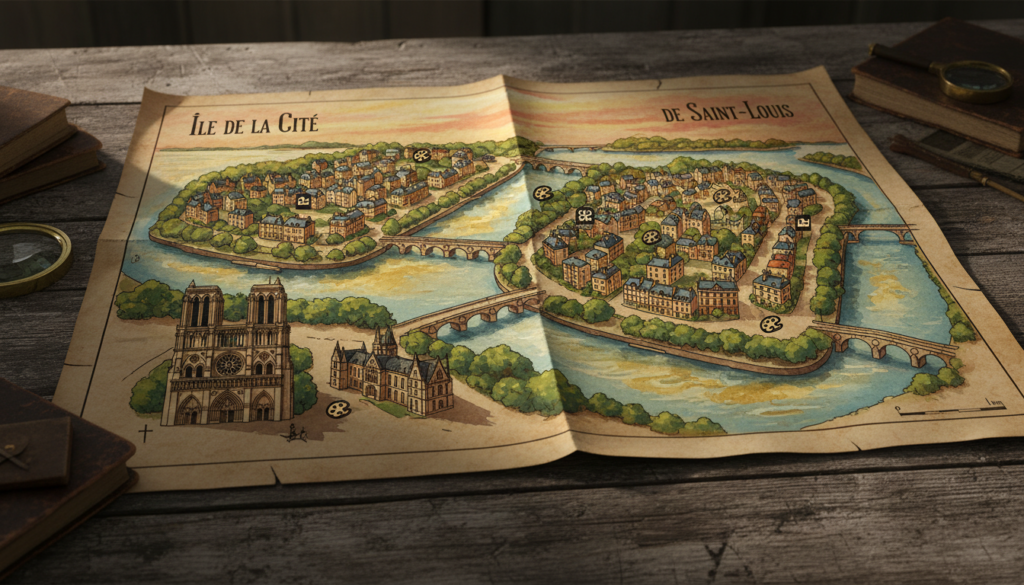
Your map of attractions in Paris on the historic islands shows where the Romans first settled. The two islands in the Seine—Île de la Cité and Île Saint-Louis—hold medieval treasures. These islands are key stops on any Paris landmarks guide.
Walking between these islands takes just minutes. You’ll travel through centuries of French history. The islands are easy to reach via Metro Line 4 to Cité station or RER B to Saint-Michel Notre-Dame. Spend at least a half-day to explore both islands well.
The Rebirth of a Gothic Masterpiece
Notre-Dame Cathedral on Île de la Cité is at the heart of Paris. It reopened in December 2024 after a major fire in 2019. The interior is beautifully restored, with some exterior work still ongoing.
The cathedral started in 1163 and shows medieval building techniques. Its towers, buttresses, and rose windows are stunning examples of 12th-century craftsmanship. Look for the Point Zéro des Routes de France bronze star in the plaza.
The cathedral dominates Île de la Cité and is a key spot on any paris landmarks map. While some exterior work continues, the interior is now open to visitors. The restoration preserved the cathedral’s history and made it stronger for the future.
Medieval Splendor in Stained Glass and Stone
Close to Notre-Dame, Sainte-Chapelle and the Conciergerie are on the western side of Île de la Cité. Sainte-Chapelle is known for its stunning interior, built in 1248 by King Louis IX.
The chapel’s upper level has 15 spectacular stained-glass windows showing 1,113 biblical scenes. On sunny days, the light creates an ethereal atmosphere. The windows are 15 meters high and cover 600 square meters of glass.
The Conciergerie next door has a darker history. It was a Revolutionary prison where Marie Antoinette spent her final days before execution. You can see her cell and learn about the Reign of Terror.
Buying a combined ticket for both sites saves money and time. They share the same entrance complex. These monuments are great together on your paris landmarks guide itinerary.
A Quieter Island Experience
The île saint-louis riverside walk offers a calm atmosphere. The island has 17th-century townhouses, boutiques, and tree-lined quays for strolling. It’s a peaceful contrast to Notre-Dame.
Walking the island’s perimeter along the Seine takes about 20 minutes. You’ll see beautiful views and pass elegant mansions, galleries, and the famous Berthillon ice cream shop. The narrow streets keep their historic charm.
The Quai d’Orléans and Quai de Bourbon have the best views. Street musicians perform here in summer evenings. You can reach the island via Pont Marie Metro station on Line 7, or walk from Île de la Cité.
Paris’s Oldest Bridge and Hidden Square
Pont Neuf, built in 1607, is Paris’s oldest standing bridge. It connects the western tip of Île de la Cité to both riverbanks. The bridge has 12 arches.
The bridge offers great views of the Seine River. Its semi-circular balconies were innovative for their time. Today, street performers and artists gather here, continuing a centuries-old tradition.
Behind buildings at the island’s western point, Place Dauphine is a tree-shaded triangular square that feels like a secret garden. Built in 1607 by Henri IV, the square has kept its original proportions. Small cafés line the square, offering outdoor seating for a quiet break.
When planning your route on a map of attractions in Paris on the historic islands, these two islands are perfect for a half-day walking tour. They offer a mix of architecture, art, and history in a small area. Most visitors also visit nearby Left Bank attractions for a full day of exploration.
Must-See Sites Mapped in the Louvre and Le Marais Area
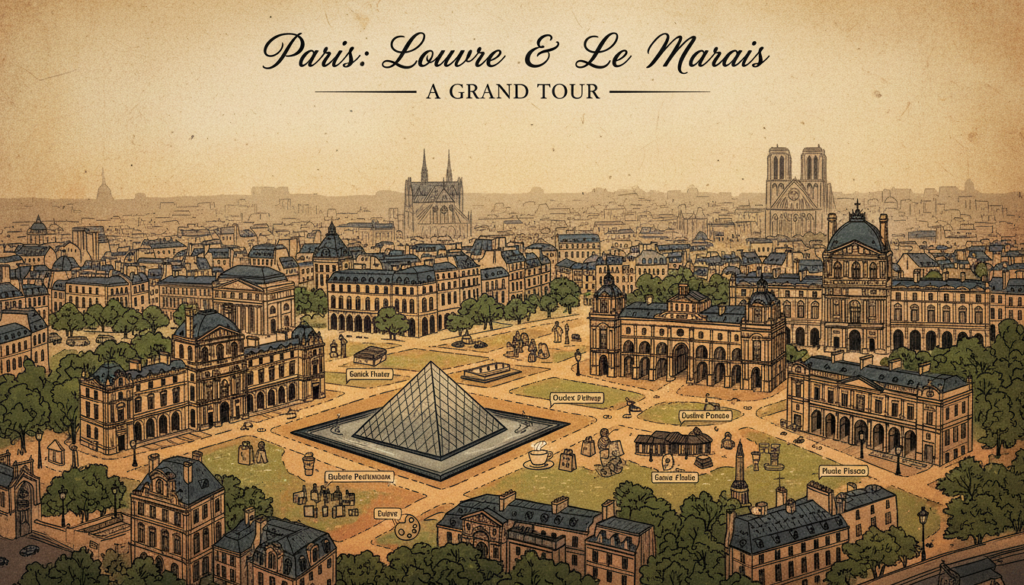
Exploring the Louvre and Le Marais area is like stepping back in time. You’ll see centuries of Paris’s art, architecture, and growth. This area, from the 1st to the 4th arrondissement, is packed with history. Walking here, you’ll find many Paris attractions to explore for days.
This area is home to world-class museums and landmarks. They’re all close together, making it easy to visit them. Your choice of where to stay affects how you see these sites. Staying in the 1st to 4th arrondissements gets you closer to the action.
Musée du Louvre and Cour Carrée
The Musée du Louvre is the world’s most visited museum. It’s huge, with 35,000 works in 400 rooms. The famous glass pyramid entrance by I.M. Pei leads to famous pieces like the Mona Lisa.
Visiting the Louvre requires planning. No ticket offices exist onsite, so buy timed-entry tickets online. Paris City Vision offers guided tours in English with fast-track access. The museum opens at 9:00 AM, best for avoiding crowds.
Getting there is easy via the Palais-Royal / Musée du Louvre station. Spend at least 3-4 hours to see the highlights. Visitors under 18 get in free with ID. The museum’s size means you need a plan to see what you want.
The Cour Carrée offers a quieter side of the museum. It shows Renaissance architecture and is a peaceful contrast. Walking through, you’ll see the building’s royal past before entering the galleries.
Place des Vosges and Musée Carnavalet
Le Marais’s Place des Vosges is Paris’s oldest square. It’s filled with red-brick townhouses and arcades. Victor Hugo’s former home is now a museum dedicated to his life and works.
The square’s garden is perfect for resting. The arcades offer shelter from rain and shade in summer. This area mixes historic elegance with modern culture.
The Musée Carnavalet tells Paris’s history from prehistoric times to the Revolution. It has 625,000 works, including paintings and furniture. Admission is completely free, making it a great value.
Explore rooms decorated in different styles to see how Parisians lived. The museum reopened in 2021 after renovations. Plan 2-3 hours for a full visit.
Centre Pompidou
The Centre Pompidou shocks visitors with its radical design. Its colorful pipes and structural elements are on the outside. Architects Renzo Piano and Richard Rogers designed it in 1977.
Inside, you’ll find Europe’s largest modern and contemporary art collection. Works by Picasso and Matisse are on display. The building also has a library, cinema, and performance spaces.
Visiting the top floor is free and offers great views. The square at ground level is lively with street performers. This square is a cultural hub.
Metro stations Rambuteau and Hôtel de Ville make it easy to get there. The Centre Pompidou is a must-see for its architecture and art. Plan 2-3 hours for a visit.
Hôtel de Ville
The Hôtel de Ville is a grand building with a Neo-Renaissance façade. It’s Paris’s city hall and has been since 1357. The current building dates to 1882.
You can see free exhibitions in the public spaces. These shows focus on Paris’s history and culture. Check the website for public access.
In winter, the square has a free ice rink. It’s open from December to February. The square also hosts cultural events and markets.
Metro Hôtel de Ville station is right next to the square. The building is along the Seine, making it easy to explore.
| Attraction | Estimated Visit Time | Admission Cost | Nearest Metro Station |
|---|---|---|---|
| Musée du Louvre | 3-4 hours minimum | €17 (free under 18) | Palais-Royal / Musée du Louvre (Lines 1, 7) |
| Musée Carnavalet | 2-3 hours | Free | Saint-Paul (Line 1) |
| Centre Pompidou | 2-3 hours | €14 (rooftop view free) | Rambuteau (Line 11) |
| Hôtel de Ville | 30-60 minutes | Free (when open) | Hôtel de Ville (Lines 1, 11) |
Walking between sites reveals hidden gems like Le Marche des Enfants Rouges. This market has international food stalls. The Jewish quarter is famous for falafel and bakeries.
Rue des Francs-Bourgeois connects Place des Vosges to the Centre Pompidou. It’s lined with boutiques and art galleries. This area is pricey but offers a glimpse into Parisian style.
Metro Line 1 runs along the district, stopping at key stations. This makes it easy to move between sites. But walking reveals more of Paris’s hidden spots.
Purchase all museum tickets in advance to avoid long lines. Paris City Vision offers skip-the-line tours. Early morning visits are less crowded, but the Louvre stays busy.
Attractions on the Left Bank and Latin Quarter
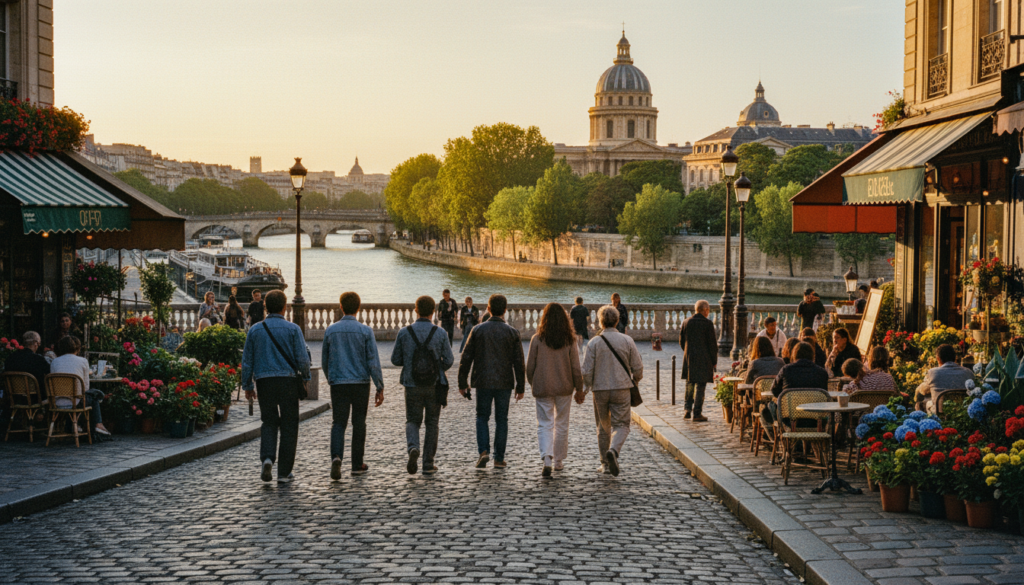
South of the river, the Latin Quarter calls with its market streets, grand monuments, and gardens. These have inspired many Parisians. The area spans the 5th, 6th, and parts of the 7th arrondissements. It’s where students, intellectuals, and artists have gathered for centuries.
The atmosphere here is different from the Right Bank’s grandeur. You’ll find intimate cobblestone lanes and authentic local experiences. Your Paris travel guide map will show these attractions on the Left Bank and Latin Quarter within walking distance. The area is best explored slowly, with unexpected discoveries around every corner.
A Monument to French History and a Market Street Experience
The Panthéon stands out from its hilltop in the 5th arrondissement. It was once a church dedicated to St. Genevieve. Now, it honors France’s greatest citizens.
Inside, Foucault’s Pendulum shows Earth’s rotation in real-time. The crypt holds the remains of famous French figures. Walking among these tombs connects you to centuries of French intellectual achievement.
Walking down from the Panthéon, Rue Mouffetard leads you into everyday Parisian life. This market street has been around since medieval times. It’s lined with cheese shops, bakeries, produce vendors, and affordable bistros.
Students from nearby Sorbonne University often visit the cafés and restaurants here. This keeps prices reasonable and the atmosphere authentic. You’ll find the true character of the Latin Quarter Paris along this lively pedestrian route.
Place de la Contrescarpe at the street’s upper end is a charming square. It’s perfect for people-watching over coffee. This area offers genuine local flavor without tourist prices.
Paris’s Most Beloved Garden Sanctuary
Jardin du Luxembourg offers 25 hectares of French gardens west of the Panthéon. The Italian Renaissance-style Luxembourg Palace anchors the northern end. It houses the French Senate now.
Children sail toy boats in the octagonal pond while adults relax in iconic green metal chairs. The Medici Fountain is a romantic shaded retreat with its long reflecting pool and Italian-style sculptures. Puppet shows entertain younger visitors on weekends and Wednesday afternoons.
Tree-lined promenades divide the gardens into formal flower beds and open lawns. Picnics and sunbathing are encouraged. The garden is a perfect midday break between museum visits, offering beauty and relaxation. Your Paris sightseeing map should mark this as a must-see.
Impressionist Masterpieces in a Beaux-Arts Railway Station
The Musée d’Orsay is in a beautifully converted 1900 railway station. It’s across the Seine from the Tuileries. This museum specializes in works from 1848 to 1914, showcasing Impressionist and Post-Impressionist masterpieces.
Inside, you’ll see iconic works by Monet, Renoir, Degas, Van Gogh, Cézanne, and Gauguin. Many find this museum more enjoyable than the Louvre. The focused collection and better sight lines make for a satisfying visit.
The top-floor galleries show the building’s original architecture. You can see the Seine and Sacré-Cœur on Montmartre’s distant hill. Spend several hours here to fully appreciate the collection.
| Museum Feature | Musée d’Orsay | The Louvre |
|---|---|---|
| Primary Collection Focus | Impressionist & Post-Impressionist art (1848-1914) | Ancient civilizations through 19th century |
| Average Visit Duration | 2-3 hours for highlights | 4-6 hours minimum |
| Crowd Density | Moderate, more manageable flow | Very high, especially near major works |
| Building Architecture | Converted Beaux-Arts railway station with natural light | Historic palace with traditional galleries |
Medieval Treasures and Roman Ruins Combined
Musée de Cluny – Medieval Paris showcases the Middle Ages through exceptional artifacts. The “Lady and the Unicorn” tapestry series is a highlight. These six panels depict the senses with exquisite detail.
The museum also features remarkably preserved 1st-century Roman thermal baths. The frigidarium (cold bath room) stands largely intact. This unique combination lets you explore both Roman Lutetia and medieval Paris in one place.
The collection includes stained glass, illuminated manuscripts, religious sculptures, and everyday objects. It provides context for understanding medieval life beyond castles and cathedrals. History enthusiasts will appreciate the museum’s scholarly approach to this period.
These attractions on the Left Bank and Latin Quarter are easy to reach via Metro Line 10. RER B and C lines also provide quick access to other districts and major train stations. The area is highly walkable, with most points of interest Paris travelers seek within a comfortable stroll.
Plan a full day for this district to avoid rushing. Start at Musée d’Orsay when crowds are lightest. Enjoy lunch along Rue Mouffetard, relax in Jardin du Luxembourg in the afternoon, and visit the Panthéon late in the day. This pacing lets you enjoy both the cultural treasures and the neighborhood atmosphere that define the Left Bank’s appeal.
Map of Attractions in Paris Around Montmartre and Northern Districts
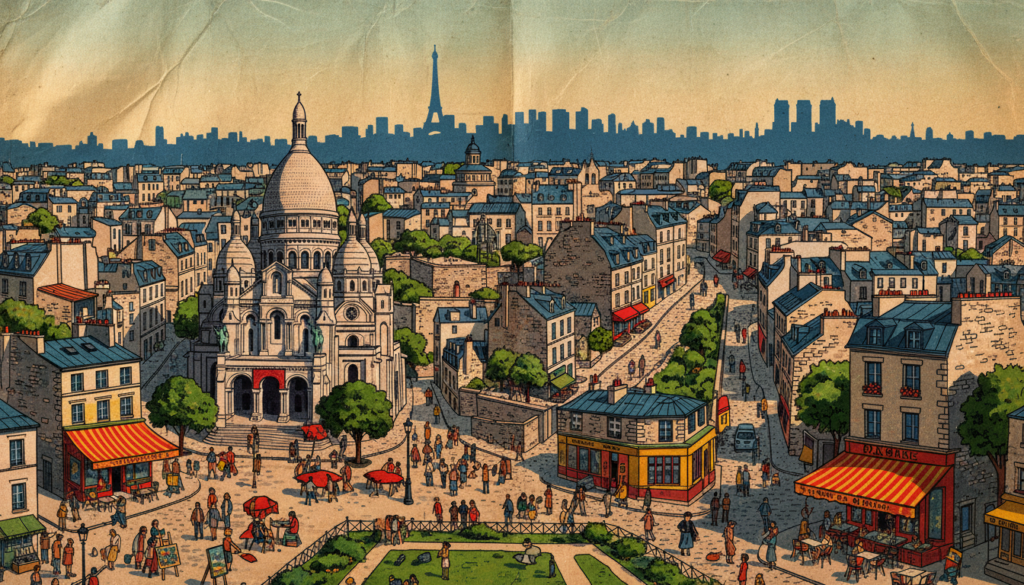
The northern parts of Paris show a different side of the city. You’ll find bohemian history and artistic legacy in the 18th, 10th, and 19th arrondissements. These areas offer unique experiences and stunning views, making them some of the top sights in Paris.
These districts have a unique charm that goes beyond the famous landmarks. Montmartre is known for its village feel and artist studios. The Canal Saint-Martin area is popular with its independent shops and cafés by the water.
Sacré-Cœur Basilica and Place du Tertre
The Sacré-Cœur Basilica sits atop Montmartre hill. Its white domes are a landmark in Paris. Inside, you’ll find France’s largest mosaic, showing Christ with outstretched arms.
Getting to Sacré-Cœur is easy. You can climb 270 steps or take the funicular. The Abbesses metro station offers a gentle climb through beautiful streets.
Place du Tertre is behind the basilica. It’s a lively square filled with artists and cafés. Visit early to avoid the crowds.
Moulin Rouge and Boulevard de Clichy
The Moulin Rouge is famous for its can-can shows since 1889. It’s a symbol of Paris’s nightlife. Toulouse-Lautrec’s posters of its dancers are famous.
Shows at the Moulin Rouge cost around €200. But you can see the outside for free. It’s a place of glamour and French culture. You can get there by Metro Line 2 at Blanche station.
Boulevard de Clichy is east of the Moulin Rouge. It’s known for its nightlife and the Moulin de la Galette. You’ll find concert venues and a mix of entertainment.
Canal Saint-Martin Walking Route
The Canal Saint-Martin walking route is 4.6 kilometers long. It runs from République to Parc de la Villette. This area is known for its independent shops and cafés.
The route has nine locks and romantic bridges. It’s perfect for photos. Locals enjoy picnics here, especially on Sundays. The walk takes about an hour or two with stops.
- Metro access via Lines 5 and 11 at République or Goncourt stations
- Best visited Sunday afternoons for local atmosphere
- Numerous cafés and restaurants along the route
- Free walking experience with optional shopping stops
Parc des Buttes-Chaumont
Parc des Buttes-Chaumont is Paris’s most dramatic park. It was built on a former quarry. The park has a 50-meter cliff, a lake, and a waterfall.
This park is a masterpiece from the Second Empire period. It offers stunning views and walking paths. You can get there by Metro Line 7 at Botzaris or Buttes-Chaumont stations.
When exploring northern Paris, remember it’s farther from the center. Montmartre is 4 kilometers from the Louvre. Canal Saint-Martin and Parc des Buttes-Chaumont are 3-4 kilometers east. These must-see Paris destinations offer unique experiences and views.
Digital and Printable Map Tools for Planning Your Visit
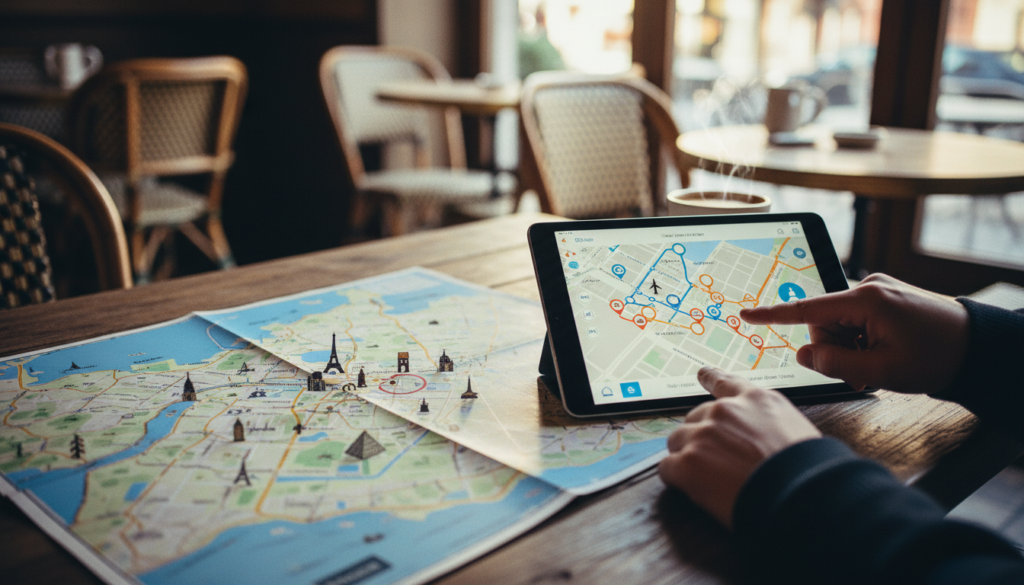
Before you hit the streets of Paris, having the right maps can save you time and stress. The best digital and printable map tools for planning your visit make all the difference. Today, you can use smartphone apps, offline maps, and official tourism guides to plan your trip.
There are many ways to navigate Paris, from planned routes to exploring freely. Having different map options helps you stay on track during your trip.
Creating Custom Location Lists with Google Maps
The google maps custom lists for paris attractions feature is a top free tool. It lets you organize your destinations before you go. You can make lists for different days, meals, or activities.
Start by searching for Paris attractions and click “Save.” Organize saved places into lists like “Day 1 Route” or “Best Cafes.” These lists are synced across all your devices.
Your custom maps show color-coded pins for easy planning. Add notes to each spot with details like opening hours or ticket prices. The app also calculates travel times between spots, helping you plan your day.
Sharing your maps is easy for group travel. Send your Paris map to friends so everyone has the same info. Some travelers share their lists online, letting you customize them for your trip.
Google Maps is great for navigating streets worldwide. It offers detailed walking directions, metro lines, and user reviews. Download the Paris area for offline use when you lose data.
Real-Time Public Transportation Navigation
Citymapper for real-time navigation between sites is better than general apps in big cities. It combines metro, bus, and bike-share into smart routes.
Citymapper shows exact departure times and platform numbers. It helps you find the best route and warns about service disruptions. The app compares different routes for you.
It suggests the fastest route, fewest transfers, and scenic walks. Arrival times update as you travel, adjusting for delays.
The underground tracking feature is key in Paris metro stations. Since GPS doesn’t work underground, Citymapper uses station stops. The “Get Me Somewhere” feature guides you with vibration alerts.
Real-time alerts tell you about strikes or line closures affecting your route. This helps you adjust plans quickly, avoiding surprises at metro entrances.
Official Tourism Planning Resources
The paris convention bureau interactive online map offers detailed planning with official info. It covers over 300 attractions, hotels, and restaurants across the city.
Filter locations by criteria like category, arrondissement, or accessibility. Each spot has detailed info, including opening hours and prices. You can build itineraries online and email them for later reference.
The interactive paris attractions map is accurate, unlike some crowdsourced platforms. Official info is updated regularly. While it works better on desktops, it’s great for detailed research before your trip.
Offline Navigation Backup Options
Always have downloadable offline maps for use without data as a backup. Apps like Maps.me and OsmAnd offer detailed walking maps. These include paths through parks and building names, often missing from commercial maps.
Paris City Vision offers a free downloadable paris tourist map in PDF format. This map includes practical details like high-speed train stations and walking itineraries. It’s a reliable guide without internet.
Download these maps before leaving home using WiFi. Avoiding mobile data for large files saves money and time. The downloadable paris tourist guide materials are perfect for when your phone runs out of battery or you want to take a break from screens.
The best approach is to use multiple navigation tools. Use Google Maps for planning and saving spots. Switch to Citymapper for real-time transit. Use the official Paris tourism map for detailed attraction info and tickets. Keep an offline map ready for when you lose data.
This multi-tool strategy ensures you always have a way to navigate, even with technical issues or no data.
How to Plan Walking Routes Using a Map of Attractions in Paris
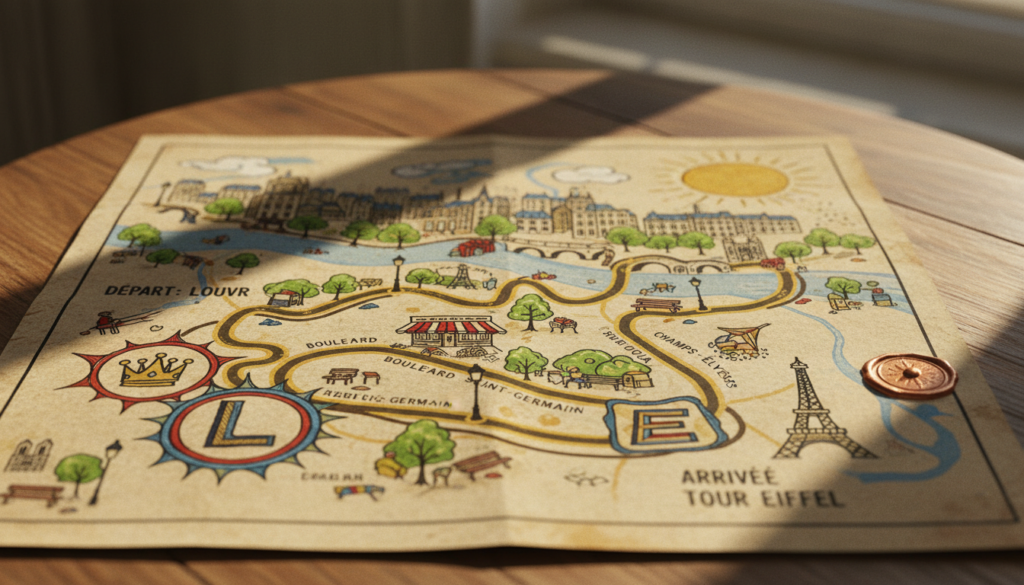
Planning walking routes in Paris can turn overwhelming lists into manageable adventures. It’s all about understanding geographic clusters and timing your visits. Your route should follow the city’s layout, not zigzag across arrondissements.
Study your paris attractions walking map to find sites in the same neighborhood. This saves time and lets you enjoy each district’s unique vibe. A good paris travel itinerary considers opening hours and meal times.
The best paris attractions walking tour routes are logical and respect distance and chronology. Start at museums early to avoid crowds, visit outdoor monuments midday, and save evening for landmarks like the Eiffel Tower.
Quick Start Morning Route
Your one-day highlight route from louvre to eiffel tower is the quintessential Paris experience. It covers famous landmarks while following the Seine. You’ll walk about six kilometers, but the experience takes ten to twelve hours.
Start at the Louvre with a pre-booked 9:00 AM entry. Arrive early to clear security. Spend two to three hours inside on the Mona Lisa, Venus de Milo, and Winged Victory of Samothrace. Pre-booking your timed entry eliminates the frustration of standing in long ticket queues.
Exit the Louvre into the Tuileries Gardens around 11:30 AM. Walk west through these tree-lined paths toward Place de la Concorde. This fifteen-minute stroll refreshes you between indoor attractions.
At Place de la Concorde, you’ll stand where revolutionary guillotines once operated. You can walk up the Champs-Élysées to the Arc de Triomphe or take Metro Line 1. The metro saves energy for later attractions, while walking lets you window-shop.
Climb the Arc de Triomphe for spectacular views of Paris’s star-shaped street layout. The 284 steps reward you with perspective. After descending, find lunch in the elegant 16th arrondissement near Trocadéro.
Take Metro Line 6 to Trocadéro station for the most iconic view of the Eiffel Tower across the Seine. This elevated metro line offers glimpses of Parisian rooftops. Cross Pont d’Iéna around 3:00 PM for your pre-booked Eiffel Tower time slot, spending one to two hours ascending to the summit and savoring panoramic views.
Extended Two-Day Exploration
A two-day itinerary covering both banks allows deeper neighborhood exploration. This structure divides Paris naturally between the historic Right Bank and the artistic Left Bank. You’ll discover that each side of the Seine possesses its own personality and rhythm.
Day One focuses entirely on Right Bank treasures. Begin at Notre-Dame Cathedral on Île de la Cité when morning light filters through the rose windows. The island location makes this an ideal starting point before crowds gather. Walk next door to Sainte-Chapelle to witness its breathtaking stained glass—aim for a sunny day when light transforms the interior into a jewel box.
Continue into the Marais district toward Place des Vosges, Paris’s oldest planned square. The covered arcades shelter art galleries and boutiques perfect for browsing. Have lunch in the Jewish Quarter around rue des Rosiers, where falafel shops compete for the title of “best in Paris.”
Your afternoon includes the avant-garde Centre Pompidou with its inside-out architecture. The building’s colorful exterior pipes and escalators create a striking contrast with medieval Marais streets. Walk through Les Halles shopping district to reach the Louvre for a late afternoon visit with your timed-entry ticket, when tour groups have departed.
Day Two explores the Left Bank’s intellectual and artistic heritage. Start when Musée d’Orsay opens at 9:30 AM (remember, it’s closed Mondays). Spend two to three hours with the Impressionist masterpieces housed in this former railway station. The building’s architecture rivals the art collection.
Walk along the Seine’s Left Bank toward the Eiffel Tower for a midday visit. The riverbank path offers bouquiniste book stalls and romantic bridges. After lunch at a traditional Left Bank café, explore the Latin Quarter’s narrow streets including the Panthéon and Luxembourg Gardens. End your evening with dinner in Saint-Germain-des-Prés, where Hemingway and Sartre once debated philosophy over coffee.
Complete Three-Day Experience
The three-day route including montmartre and day trips builds upon your two-day foundation by adding Montmartre’s hilltop charm and optional excursions. This comprehensive paris travel itinerary balances major highlights with neighborhood wandering and cultural immersion. Many families find this three-day structure ideal for experiencing Paris without exhaustion.
Day Three starts with an early morning assault on Montmartre before tour buses arrive. Reach Sacré-Cœur Basilica by 8:00 AM to enjoy the white domes and city views in relative solitude. The morning light illuminates Paris spread below you like a three-dimensional map.
Explore Place du Tertre where artists set up easels to paint and sketch tourists. While touristy, the square captures Montmartre’s artistic soul if you arrive early. Visit the Musée de Montmartre to understand the neighborhood’s bohemian past, or explore Dalí Paris if surrealism intrigues you.
Walk downhill through Pigalle, stopping at the iconic Moulin Rouge windmill. The neighborhood transforms from sacred hilltop to secular entertainment district within blocks. Have lunch near Canal Saint-Martin, where locals picnic along the water’s edge and vintage shops line the streets.
Spend your afternoon at Musée Rodin’s sculpture gardens or shopping in Le Marais boutiques you missed on Day One. This flexible afternoon allows you to revisit favorites or pursue personal interests. Consider booking a Seine dinner cruise or Moulin Rouge show for evening entertainment.
This three-day structure mirrors successful family itineraries that balance famous attractions with authentic neighborhood experiences. One family’s approach included Pink MaMma for lunch, Shakespeare Cafe for coffee breaks, and kid-friendly timing that accommodated limited walking with elderly relatives. Their itinerary proved you can see highlights without being “fully touristy.”
Extend your three days with excursions to Versailles (take RER C for a full-day trip), Giverny to see Monet’s gardens (half-day trip), or Disneyland Paris. These day trips provide contrast to urban sightseeing while deepening your understanding of French culture and history beyond Paris proper.
Routes for Everyone
Planning accessibility-friendly routes and métro connections requires special attention for travelers with mobility limitations, strollers, or wheelchairs. Paris presents challenges with its historic infrastructure, but thoughtful planning creates enjoyable experiences for all visitors. Understanding which stations and routes accommodate wheelchairs transforms potentially frustrating situations into smooth journeys.
Only about nine of Paris’s 302 métro stations offer full accessibility with elevators. Your paris attractions walking map should highlight accessible stations marked with wheelchair symbols. Bus lines provide better accessibility than métro trains, with ramps accommodating wheelchairs and strollers on all vehicles. RER trains and métro Line 14 feature the most comprehensive accessibility features including elevators and platform edge doors.
When creating walking routes, recognize that Paris sidewalks can be narrow and cobblestoned. Many museums have entrance steps, though most provide accessibility ramps or elevators through alternate entrances. Call ahead to confirm accessibility features and locate accessible entry points, which often differ from main entrances.
Montmartre’s steep hills and staircases present the biggest accessibility challenge. The funicular railway provides an alternative to the 270 front steps leading to Sacré-Cœur. However, the surrounding neighborhood streets remain hilly and cobbled, making extended Montmartre exploration difficult for wheelchairs.
The Batobus river shuttle stops at nine Seine locations and accommodates wheelchairs, offering a scenic accessible transportation alternative. This option combines practical transportation with sightseeing, eliminating the need to navigate metro stairs while enjoying riverfront views.
| Route Duration | Daily Walking Distance | Major Attractions Covered | Best For | Accessibility Level |
|---|---|---|---|---|
| One Day | 5-6 kilometers | Louvre, Arc de Triomphe, Eiffel Tower | Limited time visitors | Moderate (stairs at monuments) |
| Two Days | 4-5 km per day | Both banks, major museums, islands | First-time visitors | Good (can modify routes) |
| Three Days | 3-4 km per day | All highlights plus neighborhoods | Families and thorough explorers | Excellent (flexible pacing) |
| Accessible Route | 2-3 km per day | Major sites via accessible transport | Mobility limitations | Optimized for wheelchairs |
When creating routes on your paris travel itinerary map, add fifty percent to Google Maps’ suggested walking times. Tourist crowds, unfamiliar streets, photo stops, and simple atmosphere absorption all extend journey times. A fifteen-minute Google estimate realistically requires twenty to twenty-five minutes in practice.
Account for opening hours in your planning. Most major museums close Monday or Tuesday. French restaurants typically serve lunch from noon to 2:30 PM and dinner from 7:00 PM to 10:30 PM, with limited options between service periods. Research sunset times for optimal Eiffel Tower photography, as golden hour creates magical lighting conditions.
The most effective walking routes follow logical geographic patterns rather than jumping across the city randomly. Cluster two to four attractions within the same neighborhood for each half-day block. Include planned breaks at cafés or parks rather than attempting non-stop sightseeing, which leads to exhaustion and diminished enjoyment. Remember that quality experiences matter more than quantity of sites checked off your list.
Final Tips for Using a Map of Attractions in Paris
Your map of attractions in Paris is most useful when you buy tickets in advance. Get timed-entry passes for the Louvre, Eiffel Tower, and Musée d’Orsay two weeks before. This saves you hours waiting in lines.
Before you arrive, mark where to eat on your map. Use TheFork app to book restaurants 1-3 days in advance. Avoid eating near big tourist spots like the Louvre or Eiffel Tower. Instead, find authentic meals in residential areas for better prices.
Your guide should also show free places to visit. See Notre-Dame exterior, Sacré-Cœur basilica, and Luxembourg Gardens without spending a dime. Many museums offer free entry on the first Sunday of each month from October to March.
The Paris Museum Pass gives you skip-the-line access to over 60 places. Decide if visiting four or five major attractions is worth the cost. Note which sites accept this pass on your map.
Don’t pack your days too tight. Choose three to four major attractions each day. Leave room for unexpected finds that make your trip special. Your map is a guide, not a strict plan.
FAQ
What is the best map tool for planning my Paris attractions visit?
Google Maps Custom Lists is the top free tool for planning Paris attractions. You can save locations into lists like “Day 1 Itinerary” or “Museums to Visit.” These lists sync across devices and show color-coded pins with walking or transit times.
For real-time navigation, Citymapper is better than Google Maps. It combines metro, bus, RER trains, and walking into multi-modal route suggestions. It shows exact departure times, platform numbers, and service disruptions.
The best approach is to use Google Maps for pre-trip planning and organizing saved locations. Use Citymapper for real-time transportation navigation between sites. And have a downloadable offline map as backup when you lose connectivity.
How is Paris divided by arrondissement and which districts should tourists prioritize?
Paris has 20 administrative districts called arrondissements. They spiral outward from the city center like a snail shell. The 1st arrondissement is at the Louvre, and the 20th is in the northeastern corner.
The lower-numbered arrondissements (1-8) have most major tourist attractions. The higher numbers (9-20) have more residential areas and fewer landmarks. For first-time visitors, focus on the 1st through 8th arrondissements.
This area includes the Louvre, Champs-Élysées, Eiffel Tower, Latin Quarter, Saint-Germain-des-Prés, and the Marais. It puts you close to major attractions, but accommodation costs more.
The Seine River divides Paris into the Right Bank (Rive Droite) and the Left Bank (Rive Gauche). The Right Bank has grand boulevards and luxury shopping. The Left Bank is known for intellectuals, artists, and students.
Do I need to purchase tickets in advance for Paris attractions?
Yes, buying tickets in advance for major attractions is essential. It saves 1-3 hours of queue time at each site. The Louvre, Eiffel Tower, Versailles, Musée d’Orsay, Sainte-Chapelle, and Arc de Triomphe all require timed-entry tickets.
Book these tickets 2-4 weeks before your visit, especially during peak season. The Louvre no longer has on-site ticket offices. Book Eiffel Tower tickets weeks in advance to avoid long lines.
For Sainte-Chapelle, combined tickets with the Conciergerie save time and money. The Paris Museum Pass provides admission to 60+ museums and monuments with skip-the-line access. It’s worth it if you visit 4-5 major sites, but it doesn’t include the Eiffel Tower.
What are the key differences between the Right Bank and Left Bank of Paris?
The Right Bank (Rive Droite) has grand boulevards, luxury shopping, and major museums. The Left Bank (Rive Gauche) is known for intellectuals, artists, and students. It has the Latin Quarter, Saint-Germain-des-Prés, and the Eiffel Tower.
The Right Bank is grander and more commercial. The Left Bank has a bohemian atmosphere and academic heritage. Both sides have essential attractions worth exploring.
How much walking is required between major Paris attractions?
Central Paris attractions are walkable, 15-30 minutes between major sites. The Eiffel Tower and Trocadéro area can be explored in 30-45 minutes. You can take Metro Line 6 for elevated views.
The Champs-Élysées axis from the Louvre to the Arc de Triomphe is a 3-kilometer walk. Walking from the Louvre to the Marais takes about 30 minutes. Plan for extra time due to tourist crowds and navigating unfamiliar streets.
What are the must-see attractions for a first-time visitor to Paris?
First-time visitors should see the Eiffel Tower, Louvre, Notre-Dame Cathedral, Sainte-Chapelle, Arc de Triomphe, and Musée d’Orsay. A one-day highlight route connects these attractions, covering about 5-6 kilometers of walking.
This route takes 10-12 hours, including time in attractions. A two-day itinerary covers both banks, with Day One on the Right Bank and Day Two on the Left Bank. A three-day route includes Montmartre and day trips.
Which Paris attractions are free or offer free admission days?
Many attractions are free: Notre-Dame Cathedral exterior, Sacré-Cœur Basilica, Tuileries and Luxembourg Gardens, Champs-Élysées, and most church interiors. The Musée Carnavalet is also free.
On the first Sunday of each month from October through March, major attractions offer free admission. The rooftop of Printemps department store offers a free 360-degree city panorama. Wallace fountains provide free potable water throughout the city.
Free public toilets are located in major parks, museums, and some metro stations. Balance paid admissions with these free sites to manage your budget.
How can I avoid crowds at popular Paris attractions?
Start early at major attractions with pre-booked entry times. Arrive at the Louvre with a 9:00am ticket. Reach Sacré-Cœur by 8:00am before tour groups.
Book your Eiffel Tower tickets weeks in advance to avoid long lines. Visit popular attractions on weekdays rather than weekends. Arrive before 9:00am at Place du Tertre in Montmartre to see it empty.
Summer evening visits to Eiffel Tower or Montmartre are pleasant and less crowded. Consider visiting the quieter Cour Carrée at the Louvre instead of the crowded pyramid area.
What is the best way to navigate Paris using metro and public transportation?
The Paris metro system is efficient for navigating the city. Metro Lines 1, 4, and 14 traverse central Paris directly. Line 6 offers elevated views between Trocadéro and Nation.
RER B and C provide quick access from airports and to Versailles. Purchase a carnet of 10 t+ metro tickets for €17.35. Consider the Navigo Découverte weekly pass for €30.75 if staying Monday-Sunday.
Citymapper offers real-time navigation beyond Google Maps. It combines metro, bus, RER trains, and walking into multi-modal route suggestions. It shows exact departure times and service disruptions.
Only about 9 of 302 metro stations are fully accessible. Plan routes using accessible stations marked with wheelchair symbols. RER and metro Line 14 have the most accessibility features.
How many days do I need to see Paris’s main attractions?
At least three days are needed to see Paris’s main highlights without rushing. A one-day highlight route covers the Louvre, Champs-Élysées, Arc de Triomphe, and Eiffel Tower in 10-12 hours.
A two-day itinerary covers both banks, with Day One on the Right Bank and Day Two on the Left Bank. A three-day route includes Montmartre and day trips. Don’t over-schedule your itinerary.
Quality over quantity applies to Paris sightseeing. Select 3-4 major attractions per day maximum, interspersed with meals and walking.
What attractions are located on Île de la Cité and Île Saint-Louis?
Île de la Cité and Île Saint-Louis are historic islands in the Seine. They form the heart of Paris, founded over 2,000 years ago. Notre-Dame Cathedral dominates the island’s eastern end.
The Point Zéro des Routes de France marks the geographic center. Sainte-Chapelle features 15 spectacular stained-glass windows. The Conciergerie served as a Revolutionary prison where Marie Antoinette spent her final days.
Île Saint-Louis offers a quieter atmosphere with 17th-century townhouses and artisan shops. Walking the island’s perimeter takes about 20 minutes. Pont Neuf and Place Dauphine bookend the western tip.
What are the best downloadable offline maps for Paris?
Google Maps offers an offline download feature for Paris. Dedicated offline map apps like Maps.me, OsmAnd, and CityMaps2Go use OpenStreetMap data. Paris City Vision offers a free downloadable PDF map designed by locals.
This map includes not just attractions but practical details like high-speed train stations and free drinking water fountains. Download these offline maps before leaving home or at your hotel WiFi. They provide essential backup navigation when you lose connectivity.
What should I know about museum opening days and hours in Paris?
Most Paris museums close either Monday or Tuesday. Check opening days when planning your itinerary. The Louvre closes Tuesdays, while Musée d’Orsay typically closes Mondays.
Musée Rodin, Musée Picasso, and many smaller attractions also follow Monday or Tuesday closures. Many smaller attractions close Sundays. Color-code your map of attractions in Paris by days you plan to visit each area.
Museums typically open between 9:00am and 10:00am and close between 5:00pm and 6:00pm. Some offer late evening hours one or two nights per week. The Louvre requires timed-entry tickets purchased in advance, with no on-site ticket offices.
Plan to spend at least 3-4 hours at major museums like the Louvre or Musée d’Orsay for highlights. Spend multiple days for thorough exploration.
What are the best viewpoints for photography in Paris?
Photography enthusiasts should mark these viewpoints on their map of attractions in Paris: Trocadéro plaza offers the most famous frontal views of the Eiffel Tower. Pont Alexandre III provides golden Grand Palais views.
The rooftop of Printemps department store offers a free 360-degree city panorama. Pont de l’Archevêché provides classic Notre-Dame views. Sacré-Cœur’s front steps offer spectacular panoramic views over the entire metropolis.
The Arc de Triomphe’s viewing platform provides 360-degree views down all 12 radiating boulevards. The top floors of the Eiffel Tower offer unmatched aerial perspectives. The elevated Metro Line 6 between Trocadéro and Nation provides moving photography opportunities through windows.
How accessible is Paris for visitors with mobility limitations?
Paris accessibility for travelers with mobility limitations requires careful planning. Only about 9 of 302 metro stations are fully accessible. Plan routes using accessible stations marked with wheelchair symbols.
Rely on bus lines which are wheelchair-accessible with ramps. RER and metro Line 14 have the most accessibility features. Paris sidewalks can be narrow and cobblestoned, and many museums have steps at entrances.
Montmartre’s hills and stairs make it challenging for those with limited mobility. The funicular railway provides an alternative to the front steps. The Batobus river shuttle stops at nine locations along the Seine and is wheelchair-accessible.
What is the Champs-Élysées axis and what attractions are along this route?
The Champs-Élysées axis forms a nearly straight 3-kilometer line from the Louvre to the Arc de Triomphe. At the western end, the Arc de Triomphe commands attention. You can climb 284 steps to the top for panoramic views.
Moving toward the river, the Champs-Élysées avenue is lined with luxury shops and cafés. The Grand Palais and Petit Palais face each other, built for the 1900 Exposition Universelle. At the eastern end, Place de la Concorde features the 3,300-year-old Luxor Obelisk.
What are the best attractions for families with children in Paris?
Family-friendly attractions include the Eiffel Tower’s ascending experience, Jardin du Luxembourg, and Jardin des Tuileries. The Palais de la Découverte science museum near the Champs-Élysées features interactive exhibits and a planetarium.
The Canal Saint-Martin offers easy walking along the water for picnics. Parc des Buttes-Chaumont provides dramatic landscapes with a lake and waterfall. The Centre Pompidou’s plaza attracts street performers that entertain children.
A Seine river cruise on Bateaux Mouches provides a relaxing way to see monuments from water level. Versailles Palace and Gardens offer vast spaces for children to explore. Disneyland Paris makes a full-day trip option for families.
What should I know about visiting Montmartre and Sacré-Cœur?
Montmartre in the 18th arrondissement offers a distinctly different character from central Paris. The Sacré-Cœur Basilica crowns the 130-meter-high hill with its white domes visible across Paris. Its front steps provide spectacular panoramic views over the entire metropolis.
Behind the basilica, Place du Tertre represents old Montmartre’s village square. It’s filled with portrait artists and caricaturists. Arrive before 9:00am to see it empty and atmospheric before crowds.
The neighborhood is about 4 kilometers north of the Louvre, and its hills and stairs make it challenging for those with limited mobility. The funicular provides an accessible alternative.