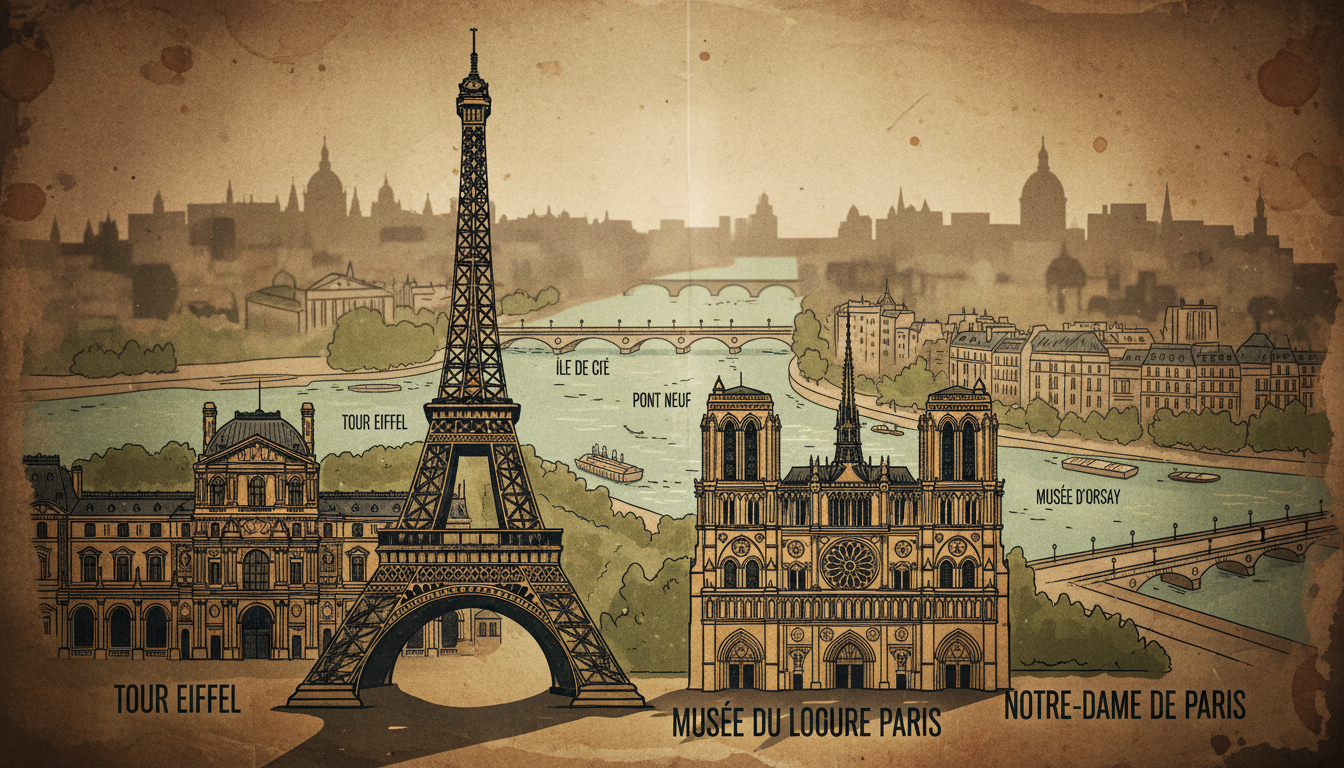
Ever felt lost trying to plan a trip to a beautiful city? Paris has 20 unique arrondissements. Each is filled with famous landmarks, top museums, and cozy neighborhoods to explore.
Without a good plan, you might spend hours lost or miss secret spots near famous places. The arrondissement system helps you get around. It’s like a snail shell, spiraling out from the center.
A detailed Paris attraction map guide shows where to find the best spots. Paris City Vision’s map includes must-see sights from the Eiffel Tower to Sacré-Cœur Basilica. It also shows transport stations and the best routes to take.
This guide helps you see more of Paris without wasting time. You’ll enjoy more culture and travel less.
Key Takeaways
- Paris organizes its attractions across 20 arrondissements in a spiral pattern from the city center
- A quality map includes major landmarks, museums, transportation hubs, and recommended walking routes
- Strategic planning helps you visit multiple attractions in the same neighborhood efficiently
- Digital and printable maps both offer unique advantages for navigation and trip planning
- Understanding the Left Bank versus Right Bank layout simplifies your itinerary creation
- Local-designed maps reveal hidden gems that typical tourist guides often overlook
How the Paris Arrondissement System Shapes Your Map
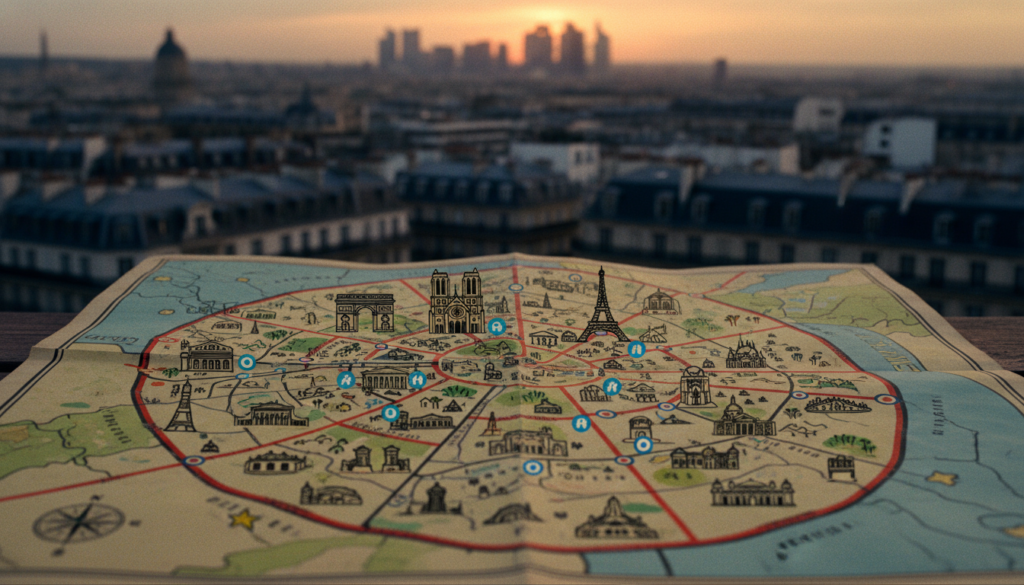
Paris divides its neighborhoods into 20 numbered districts. This system helps you plan your trip better. It affects where you stay, which attractions you see, and how you move around.
Looking at any paris sightseeing map, you’ll see these numbers across the city. Each district has its own vibe, prices, and attractions. This shapes your Paris experience.
Understanding the Spiral Layout of the Arrondissements
Paris arranges its districts in a spiral pattern. The 1st arrondissement is at the center, with famous sites like the Louvre and Île de la Cité.
The numbers increase as you move outward. The 2nd to 8th districts form a ring around the center. The 9th to 20th districts extend toward the edges.
Lower-numbered districts have most famous attractions. Staying in the 1st, 2nd, or 3rd arrondissement means you’re close to many landmarks.
Montmartre in the 18th arrondissement offers charm but is farther from central sites. The 19th and 20th arrondissements provide authentic experiences but take longer to reach major attractions.
Right Bank vs Left Bank Orientation for Tourists
The Seine River divides Paris into two sides. The Right Bank is northern, and the Left Bank is southern.
Your choice between the Right Bank and Left Bank affects your attractions. The Right Bank has commercial energy, grand boulevards, and major museums like the Louvre.
The Left Bank has an intellectual vibe, with university areas, literary cafés, and quieter streets. It’s home to the Latin Quarter and Saint-Germain-des-Prés, and the Eiffel Tower is here too.
Most visitors explore both banks. A guide suggests starting with Right Bank attractions like the Champs-Élysées. Then, explore Left Bank neighborhoods for a different view.
Dining near tourist spots like the Louvre can be pricey with lower quality. Local areas on both banks offer better food and value.
Central Arrondissements with the Highest Attraction Density
Five arrondissements are key for your Paris trip. They have the most attractions. These districts should be your base for staying and exploring.
These central districts make sightseeing easier. Staying here saves time and lets you visit landmarks spontaneously.
| Arrondissement | Bank Location | Key Attractions | Visitor Character |
|---|---|---|---|
| 1st | Right Bank | Louvre Museum, Palais Royal, Tuileries Garden | Heavily touristed, central location, historic core |
| 4th | Right Bank | Notre-Dame Cathedral, Marais district, Place des Vosges | Boutique shopping, pricier dining, vibrant nightlife |
| 5th | Left Bank | Latin Quarter, Panthéon, Jardin des Plantes | Student atmosphere, bookshops, affordable eateries |
| 7th | Left Bank | Eiffel Tower, Musée d’Orsay, Les Invalides | Elegant residential, government buildings, upscale feel |
| 8th | Right Bank | Champs-Élysées, Arc de Triomphe, Grand Palais | Luxury shopping, grand architecture, tourist-heavy |
The 6th and 9th arrondissements are also worth visiting. But the table above shows your main planning area for a first-time Paris trip.
When booking hotels, choose places close to these districts. Even if you can’t afford the 1st or 2nd, pick hotels near metro stations that connect to these areas.
The arrondissement system makes planning easier. Knowing the spiral pattern, the banks, and central districts helps you create a better Paris itinerary.
Map of Tourist Attractions in Paris Around the Eiffel Tower
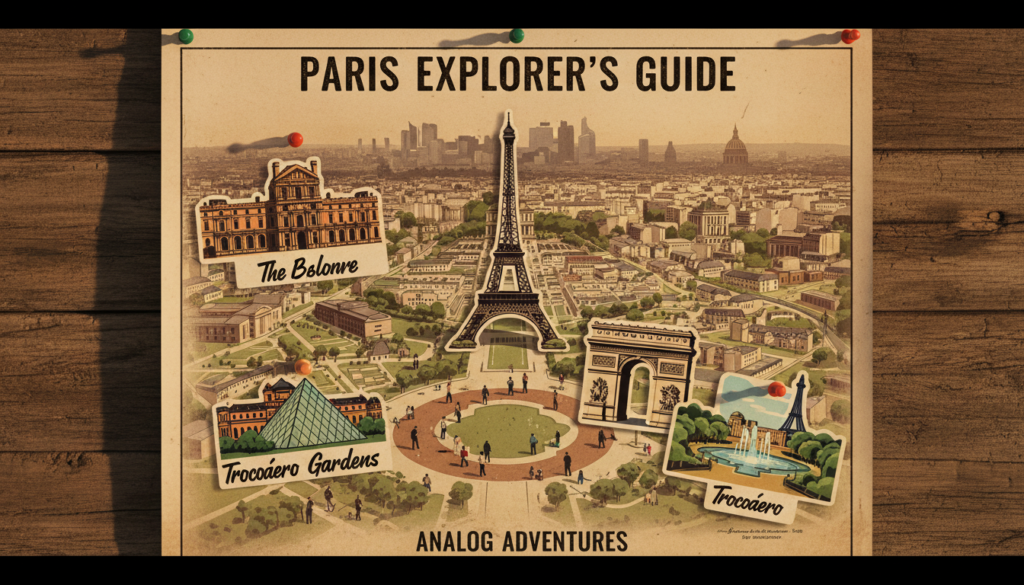
When you mark the Eiffel Tower on your Paris map, you’re in the heart of a treasure-filled area. This 7th arrondissement is packed with world-class museums and scenic views. Spend at least half a day here to see the highlights without rushing.
This neighborhood offers more than just views of the Eiffel Tower. You’ll find architectural wonders, cultural spots, and riverside walks. It’s a must-see for both first-time visitors and seasoned travelers.
The Iron Lady and Its Expansive Green Space
The Eiffel Tower and Champ de Mars are the area’s centerpiece. The 330-meter iron structure dominates the view from every angle. You can climb the 674 steps to the second floor for a real challenge or take the elevator to the top for stunning views.
Booking tickets in advance saves you from waiting up to two hours just to purchase entry, travel experts say. The Champ de Mars park stretches from the tower to the École Militaire, perfect for picnics and photos.
Getting to the Eiffel Tower is easy with many transport options. Metro stations Bir-Hakeim (Line 6) and Champ de Mars – Tour Eiffel (RER C) are just a five-minute walk away.
The Best Frontal Viewpoint Across the Seine
Trocadéro and Palais de Chaillot offer the best frontal views of the Eiffel Tower. The elevated Trocadéro plaza gives you a clear view of the Iron Lady, perfect for sunrise and sunset photos. Street performers and artists add to the lively atmosphere.
The Palais de Chaillot is more than just a viewpoint. It houses several museums, including the Cité de l’Architecture and the Musée de l’Homme. The building’s curved wings frame the Eiffel Tower beautifully from the central terrace.
You can reach Trocadéro via metro station (Lines 6 and 9). The walk from here down to the Seine and across to the Eiffel Tower takes about 15 minutes, making it easy to visit both landmarks in one day.
Indigenous Cultures in a Modern Architectural Gem
The Musée du Quai Branly is just steps from the Eiffel Tower. It showcases indigenous art and cultures from around the world. Architect Jean Nouvel designed the building with vertical gardens that blend structure and nature.
This museum is a great addition to your Eiffel Tower visit, especially on rainy days. The interior features dim lighting and thoughtful curation for an immersive experience. Visitors often spend two to three hours exploring the collection and special exhibitions.
The museum’s garden area has outdoor sculptures and is a peaceful spot to rest. Admission is €12 for adults, with reduced rates for young adults and free entry for those under 18.
Riverside Romance and River Cruise Departures
Pont de l’Alma and the Seine riverbank complete this cluster of attractions. They offer romantic walking paths and cruise departure points. The bridge connects the 7th and 8th arrondissements, with the famous Zouave statue marking the flood level.
The riverbank paths provide stunning views of passing boats and distant monuments. Several major river cruise companies launch their tours from docks near this bridge, making it a strategic point for evening cruises. These views showcase Paris’s bridges and buildings from a unique perspective.
The area is accessible all day and evening, but it comes alive at night. Street-level cafés and benches along the Seine are perfect for pausing and enjoying the atmosphere before moving on.
Mapped Attractions Along the Champs-Élysées and Right Bank
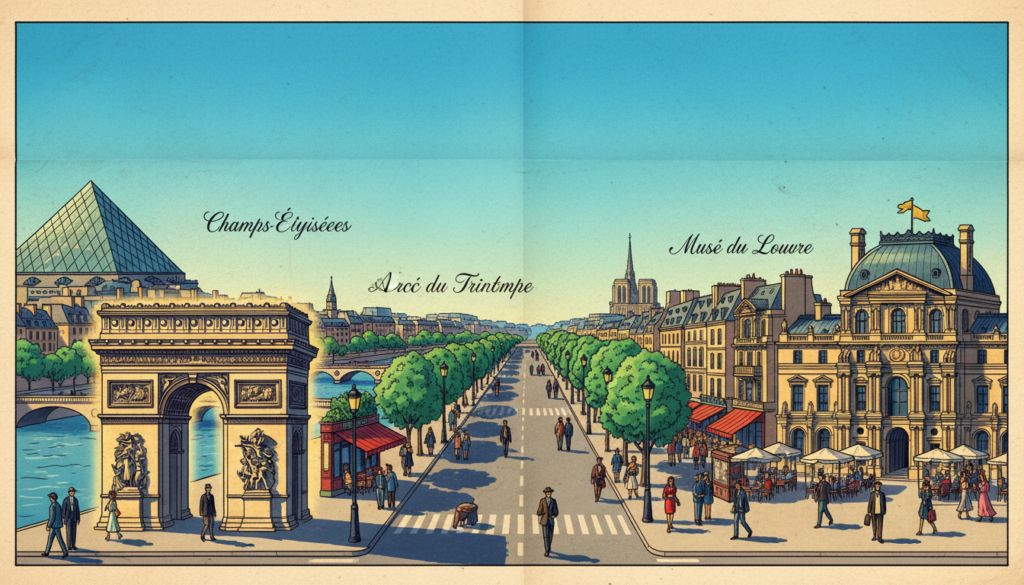
Your Paris adventure starts along the Champs-Élysées. This avenue is a mix of old history and new style. It’s nearly two kilometers long, linking famous spots.
Using a champs-élysées tourist guide, you’ll see French architecture from different times. From Napoleon to the Belle Époque, it’s all here.
The Right Bank has attractions that make a great walking path. You can spend a day here, seeing each site. Each landmark shows a piece of French culture, art, and history.
Arc de Triomphe and Place Charles de Gaulle
The arc de triomphe and place charles de gaulle are Napoleon’s triumph. They’re in the center of what was once Place de l’Étoile. Twelve grand avenues spread out like a star.
At the Arc de Triomphe, climb 284 steps for a 360-degree view. It honors France’s fighters, with names on its walls.
The Tomb of the Unknown Soldier is beneath the arch, with an eternal flame. Charles de Gaulle-Étoile Metro station (Lines 1, 2, 6) is nearby. Visit at sunset for stunning views.
Grand Palais and Petit Palais
The grand palais and petit palais face each other. They were built for the 1900 World’s Fair. Their designs show French skill from that time.
The Grand Palais has a huge glass roof. It’s perfect for art shows and events. Its roof is one of Europe’s biggest glass structures.
The Petit Palais has the City of Paris Museum of Fine Arts. It’s free to see the permanent collections. The courtyard garden is a peaceful spot.
Place de la Concorde and Jardin des Tuileries
The place de la concorde and jardin des tuileries are between the avenue and museums. Place de la Concorde is Paris’s biggest square. An Egyptian obelisk stands in the center.
This square is where Louis XVI and Marie Antoinette were executed. Now, it offers views of the National Assembly and Arc de Triomphe.
The Jardin des Tuileries has 25 hectares of gardens. It’s a calm place with cafés and rides. It’s great for a break from museums.
The gardens lead to the Louvre Museum. Concorde Metro station (Lines 1, 8, 12) is nearby.
Musée du Louvre and Palais Royal
The Louvre and Palais Royal end your Right Bank journey. The Louvre is the world’s most visited museum. It has over 10 million visitors a year.
Seeing everything takes days. The museum shows art from ancient times to the 19th century. You’ll see famous works like the Mona Lisa.
Plan your visit early. Girl Takes Mundo suggests buying tickets online. Kids under 18 get in free. Visit early or late to avoid crowds.
Palais-Royal/Musée du Louvre Metro station (Lines 1, 7) is best for the Louvre. Paris City Vision offers tours and early entry. These help you skip long lines.
Use your louvre museum map to focus on certain galleries. The museum is big. Spend at least half a day here.
Behind the Louvre, the Palais Royal gardens are peaceful. They have a modern art installation. It contrasts with the old architecture.
| Attraction | Metro Access | Recommended Time | Key Features | Visitor Tips |
|---|---|---|---|---|
| Arc de Triomphe | Charles de Gaulle-Étoile (Lines 1, 2, 6) | 1-2 hours | Panoramic views, Tomb of Unknown Soldier | Climb at sunset for best photos |
| Grand Palais | Champs-Élysées-Clemenceau (Lines 1, 13) | 2-3 hours | Glass roof, rotating exhibitions | Check exhibition schedule online |
| Place de la Concorde | Concorde (Lines 1, 8, 12) | 30 minutes | Egyptian obelisk, ornate fountains | Best viewed while walking through |
| Jardin des Tuileries | Concorde or Tuileries (Line 1) | 1-2 hours | French formal gardens, outdoor cafés | Perfect for rest between museums |
| Musée du Louvre | Palais-Royal/Musée du Louvre (Lines 1, 7) | 3-5 hours minimum | 400 rooms, 35,000 artworks, Mona Lisa | Book tickets advance, arrive early |
This route is a full-day adventure in Paris. The Champs-Élysées and Right Bank connect through metro and paths. You can set your own pace, enjoying museums or outdoor spots.
Start at the Arc de Triomphe in the morning. Then, head to the Louvre in the afternoon. This way, you see outdoor sights in daylight and museums later.
Map of Tourist Attractions in Paris on the Historic Islands
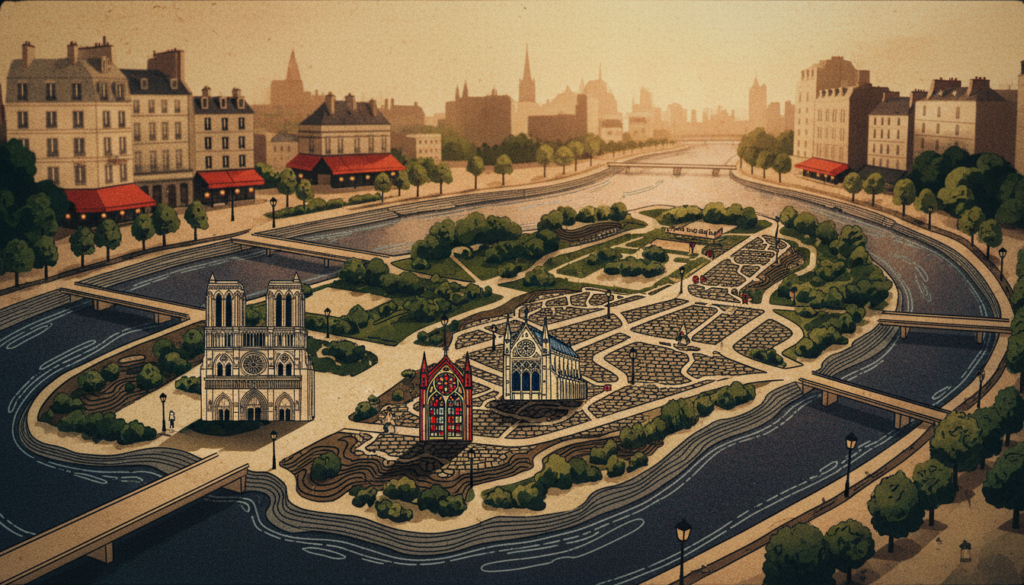
Île de la Cité and Île Saint-Louis are in the Seine’s middle. They hold key monuments in Paris’s long history. These islands are the city’s birthplace, filled with medieval treasures.
They are walkable, covering remarkable history in a half-day. The islands take you through French history, from Gothic cathedrals to revolutionary prisons. They are central, connecting Right and Left Bank attractions.
The Reopened Notre-Dame Cathedral
Notre-Dame Cathedral on Île de la Cité reopened in 2024 after a 2019 fire. It’s a Gothic masterpiece, the heart of Paris. Victor Hugo’s “Hunchback of Notre-Dame” made it famous.
The façade and rose windows survived the fire. Restoration continues, but the exterior is stunning. Inside, the stonework and spire were restored using traditional methods.
To visit, take Metro Line 4 to Cité or RER B to Saint-Michel Notre-Dame. Both are a short walk from the cathedral. Arrive early to avoid long lines, especially in peak seasons.
Medieval Masterpieces: The Royal Chapel and Revolutionary Prison
Close to Notre-Dame, Sainte-Chapelle and the Conciergerie show France’s royal and revolutionary past. Sainte-Chapelle has 15 stunning stained glass windows. They display biblical scenes in vibrant colors.
The chapel needs a separate ticket from Notre-Dame. Lines are usually shorter, making it a good choice when crowded. Visiting on a sunny day is especially beautiful as natural light enhances the glass.
The Conciergerie, next to Sainte-Chapelle, was a royal palace and prison. Marie Antoinette was imprisoned here before her execution in 1793. Today, you can see her cell and learn about the French Revolution.
Historic Bridges and Hidden Squares
Pont Neuf and Place Dauphine are historic gems. The oldest standing bridge in Paris connects the islands to the riverbanks. It offers great views of the Seine.
Place Dauphine is a peaceful square at the bridge’s western end. It has outdoor cafés for a classic Parisian experience. The 17th-century buildings around the square are well-preserved.
Walking Pont Neuf at sunset is memorable. The elevated bridge offers unique views of the Seine and its surroundings.
Residential Island Charm
Île Saint-Louis is connected to Île de la Cité by a short bridge. It has a residential feel with 17th-century houses and upscale shops. It’s a peaceful place away from the crowds.
Rue Saint-Louis-en-l’Île has specialty food shops and Berthillon ice cream. Berthillon’s ice cream is famous in Paris. Try seasonal flavors like salted caramel or wild strawberry for a taste of French quality.
The island’s riverside walks are romantic. Benches face the water, offering views of the Seine and its banks. These paths are less crowded than other areas.
| Island Attraction | Estimated Visit Time | Best Metro Access | Admission Cost |
|---|---|---|---|
| Notre-Dame Cathedral | 45-60 minutes | Cité (Line 4) | Free entry |
| Sainte-Chapelle | 30-45 minutes | Cité (Line 4) | €11.50 adults |
| Conciergerie | 45-60 minutes | Cité (Line 4) | €9.50 adults |
| Île Saint-Louis Walk | 30-45 minutes | Pont Marie (Line 7) | Free access |
Plan at least four hours for exploring the historic islands. Walking is the best way to get between sites. From the islands, you can easily reach other attractions.
Consider a Seine river cruise for a different view of the architecture. Many cruises start near Notre-Dame, making it easy to add to your tour.
Left Bank and Latin Quarter Attractions on the Map
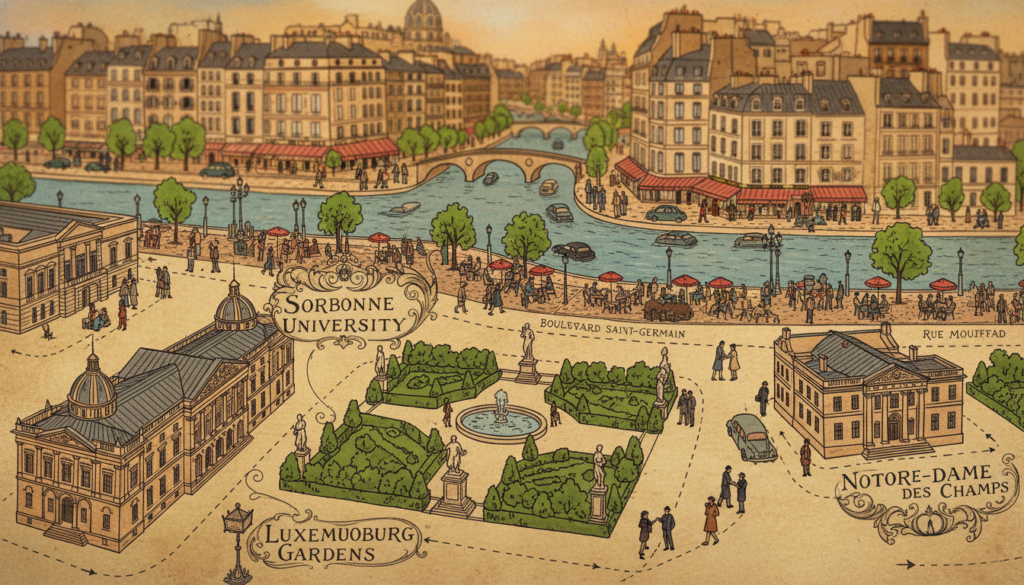
Your map of tourist attractions in Paris should highlight the Left Bank and Latin Quarter. These areas have shaped European thought and artistic movements for generations. They offer a different Paris experience compared to the Right Bank.
Here, you’ll find intimate streets, academic institutions, world-class art museums, and garden spaces. Locals gather here daily.
The atmosphere changes as you cross the Seine southward. Literary cafés, independent bookshops, and university buildings create an intellectual vibe. This has attracted writers, philosophers, and artists for centuries. When planning where to stay in Paris for the first time, consider the Left Bank’s central location and authentic Parisian character.
France’s National Monument and Historic Market Street
The Panthéon dominates the 5th arrondissement’s skyline. This neoclassical masterpiece is France’s national mausoleum. It houses the remains of distinguished citizens like Voltaire, Rousseau, Victor Hugo, and Marie Curie.
The building’s architectural grandeur matches its cultural significance. It features Corinthian columns, a massive dome, and Foucault’s Pendulum demonstration inside.
Descending from the Panthéon and Rue Mouffetard area brings you to Rue Mouffetard. This market street has a medieval character. It’s a daily gathering place for locals.
Produce vendors, fromageries, bakeries, and bistros line the street. The market operates most mornings, with the greatest selection on weekends. You can sample regional cheeses, pick up fresh bread, and observe authentic Parisian shopping habits.
Small restaurants along the street offer affordable lunch menus. They feature traditional French cuisine.
Paris’s Most Beloved Public Garden
The Jardin du Luxembourg offers 25 hectares of green space in the 6th arrondissement. Created in 1612 by Marie de Medici, these formal French gardens are a gathering place for students, families, and anyone seeking respite. The Luxembourg Palace anchors the northern end, housing the French Senate.
Activities in Jardin du Luxembourg cater to diverse interests. Children sail miniature boats in the central octagonal pond. Tennis courts, puppet theaters, and chess tables occupy different corners of the park. The ornate Medici Fountain creates a romantic setting surrounded by tree-shaded pathways.
Students from the nearby Sorbonne University frequently study on park benches or the distinctive green metal chairs scattered throughout. The gardens show how Parisians integrate public spaces into daily life, not just for tourists.
Impressionist Masterpieces in Converted Landmarks
The Musée d’Orsay occupies a stunning Beaux-Arts railway station on the Left Bank of the Seine. It houses the world’s finest collection of Impressionist and Post-Impressionist paintings. Works by Monet, Renoir, Van Gogh, Degas, and Cézanne are displayed chronologically across three floors.
The building’s dramatic architecture enhances the viewing experience. It features a massive vaulted glass ceiling and ornate clock faces.
Many travelers find Musée d’Orsay and Musée de l’Orangerie more manageable than the Louvre. The collection focuses on art from 1848 to 1914. This allows for deeper appreciation without museum fatigue. Travel experts recommend spending more time here for a more rewarding experience.
Across the Tuileries Gardens, the Musée de l’Orangerie offers an intimate encounter with Claude Monet’s monumental Water Lilies series. Two oval rooms were specifically designed to display these massive canvases. This creates an immersive environment.
The museum also features works by Cézanne, Matisse, Picasso, and other modern masters in its lower-level galleries.
Medieval Art Above Ancient Roman Ruins
The Musée de Cluny, officially known as the National Museum of the Middle Ages, presents medieval European art and daily life. The famous Lady and the Unicorn tapestries represent the museum’s crown jewels. These six allegorical hangings woven around 1500 depict the five senses plus a mysterious sixth panel.
What makes Musée de Cluny and the Roman Baths fascinating is the building’s dual historical nature. The museum partially occupies a 15th-century mansion built atop 2nd-century Roman thermal baths. You can explore the frigidarium (cold bath), one of the best-preserved Roman structures in Paris, with its soaring vaulted ceiling.
This combination of Gallo-Roman architecture and medieval art collections provides historical context spanning over a millennium. The museum remains less crowded than must-see attractions Paris like the Louvre. This allows for contemplative viewing of intricate illuminated manuscripts, stained glass, and religious sculptures.
| Museum | Primary Collection Focus | Average Visit Duration | Key Advantage | Nearest Metro Station |
|---|---|---|---|---|
| Musée d’Orsay | Impressionist and Post-Impressionist art (1848-1914) | 2-3 hours | More manageable size than Louvre; chronological layout | Solférino (Line 12) |
| Musée de l’Orangerie | Monet’s Water Lilies and modern art collection | 1-2 hours | Immersive oval rooms designed for specific artworks | Concorde (Lines 1, 8, 12) |
| Musée de Cluny | Medieval European art and Roman antiquities | 1.5-2 hours | Unique combination of Roman ruins and medieval treasures | Cluny-La Sorbonne (Line 10) |
| Panthéon | French national mausoleum and architecture | 1 hour | Panoramic views from dome; Foucault’s Pendulum | Cardinal Lemoine (Line 10) |
Navigating between left bank and latin quarter attractions on the map becomes straightforward with proper metro planning. The Luxembourg RER B station provides direct access from Charles de Gaulle Airport. Metro stations Maubert-Mutualité, Saint-Michel, and Odéon connect the major sites efficiently.
Allocate at least one full day to properly experience these paris tourist destinations. The area rewards slower exploration rather than rushed monument-hopping. Morning visits to museums before crowds arrive, afternoon relaxation in Jardin du Luxembourg, and evening strolls along Rue Mouffetard create a balanced itinerary that captures the Left Bank’s distinctive character.
Map of Tourist Attractions in Paris in Montmartre and the North
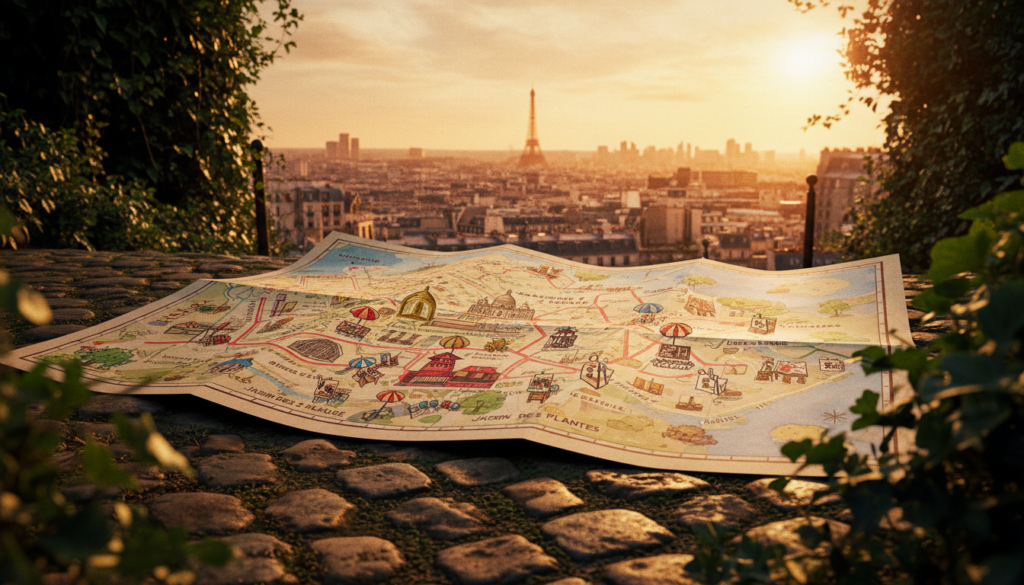
Exploring the map of tourist attractions in Paris in Montmartre and the north reveals areas unlike central Paris. These spots show the city’s artistic and bohemian sides. The cobblestone streets and hilltop views contrast with the Seine’s grand architecture.
Northern Paris has a village-like charm with trendy walks and hidden parks. Your map should highlight these areas. They offer a local atmosphere and famous landmarks that have shaped Paris for over a century.
Sacré-Cœur Basilica and Place du Tertre
The Sacré-Cœur Basilica and Place du Tertre sit atop Paris, offering stunning views. The basilica’s architecture contrasts with Notre-Dame. Inside, golden mosaics create a peaceful atmosphere.
The basilica’s steps are perfect for sunset views. Locals and tourists gather here. You can also take the funicular to avoid the steep climb.
Behind the basilica, Place du Tertre keeps Montmartre’s artistic spirit alive. Portrait painters and caricaturists work here, just like Picasso and Renoir. Outdoor cafés add to the lively atmosphere.
Montmartre is in the 18th arrondissement, requiring a climb. Anvers, Abbesses, or Blanche metro stations are best for access. Plan a half-day trip to fully experience the area.
Moulin Rouge and Boulevard de Clichy
Descending Montmartre, you’ll find the Moulin Rouge and Boulevard de Clichy. This area is known for Belle Époque glamour. The Moulin Rouge has hosted cancan shows since 1889.
The cabaret still attracts audiences with its dancers and champagne. Blanche station on Line 2 brings you right to the Moulin Rouge. Boulevard de Clichy is full of theaters, shops, and restaurants.
This area shows a different side of Paris. The neon lights and venues contrast with Sacré-Cœur’s quiet. Your top Paris destinations map should include both for a full experience.
Canal Saint-Martin Walking Route
The Canal Saint-Martin walking route is in the 10th arrondissement. It features iron bridges, cafés, and vintage shops. This area offers a break from tourist spots.
Strolling along the canal, you can watch boats and enjoy picnics. Independent shops and coffee roasters line the streets. République and Jaurès metro stations make it easy to get here.
This neighborhood feels truly Parisian. The canal route leads to Parc de la Villette for more exploration.
Parc des Buttes-Chaumont
Parc des Buttes-Chaumont in the 19th arrondissement is a surprise. It was made from old quarries and has a rocky island with a temple. The park offers stunning views and a romantic atmosphere.
This park is great for picnics away from tourists. The views across northeastern Paris are unique. Families, joggers, and couples enjoy the paths.
You can reach the park via Buttes-Chaumont or Botzaris metro stations. Pair it with Canal Saint-Martin for a perfect afternoon. Both show Paris beyond famous monuments.
| Northern Attraction | Arrondissement | Nearest Metro | Best Time to Visit | Average Duration |
|---|---|---|---|---|
| Sacré-Cœur Basilica | 18th | Anvers, Abbesses | Morning or sunset | 2-3 hours |
| Moulin Rouge | 18th | Blanche (Line 2) | Evening shows | 3-4 hours |
| Canal Saint-Martin | 10th | République, Jaurès | Afternoon | 1-2 hours |
| Parc des Buttes-Chaumont | 19th | Buttes-Chaumont | Mid-morning or late afternoon | 1-2 hours |
When visiting northern Paris, remember Montmartre is a bit of a trek. But it’s worth it for its village-like streets and views. Canal Saint-Martin and Parc des Buttes-Chaumont are easier to explore and offer a true Parisian experience.
Eastern and Outer District Attractions Worth Mapping
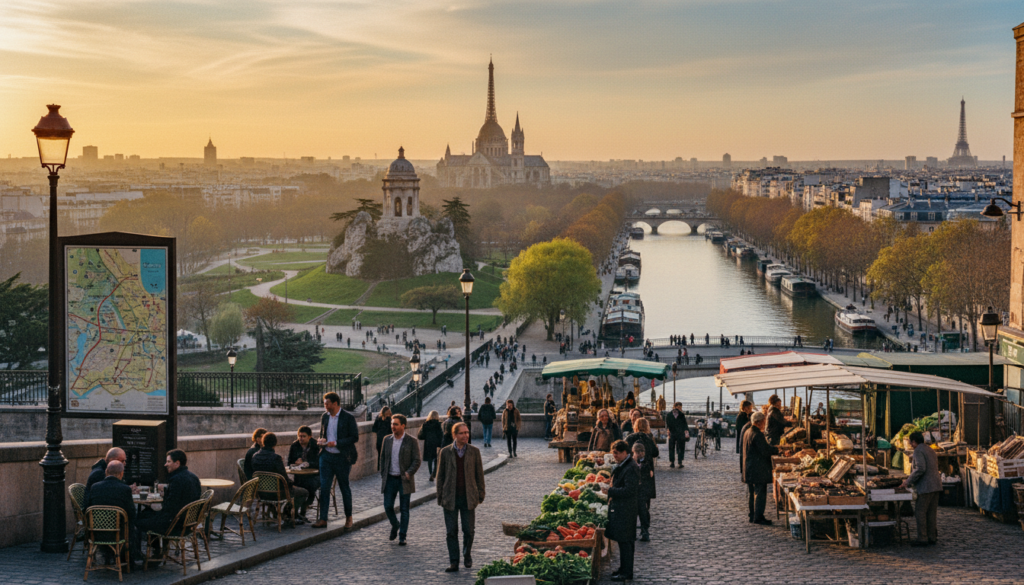
Explore beyond central Paris to find eastern and outer district attractions worth mapping. These areas offer a true Parisian experience away from the crowds. Your landmarks in paris map should include these spots for a deeper dive into the city.
The eastern arrondissements are a bit far but offer unique cultural sites. These districts are spread out, so planning is key. You’ll see peaceful parks, historic cemeteries, and vibrant neighborhoods that show Paris’s growth.
Père Lachaise Cemetery
The père lachaise cemetery in the 20th arrondissement is famous worldwide. It’s a 110-acre open-air sculpture museum with elaborate tombs. You’ll find graves of famous icons like Jim Morrison and Oscar Wilde.
Visiting the cemetery is a must for artists and history buffs. Paris City Vision highlights père lachaise cemetery as a key attraction. Spend at least two hours here to fully appreciate its beauty.
Free maps are available at the entrance. Visit on weekday mornings to avoid crowds.
Place des Vosges and Le Marais
The Marais neighborhood, in the 3rd and 4th arrondissements, is Paris’s oldest planned square. Place des Vosges and le marais feature pink brick buildings and a central garden. Victor Hugo’s home is now a free museum.
Le Marais blends medieval streets with trendy boutiques and art galleries. The Marché des Enfants Rouges offers international food stalls. Girl Takes Mundo says it’s pricier but worth it for the shopping and dining.
The area is also known for its LGBTQ+ venues and nightlife. Narrow streets like Rue des Rosiers have Jewish bakeries and falafel shops. Spend half a day exploring without a tight schedule.
Bastille and the Promenade Plantée
The Bastille area has evolved from its revolutionary past to a lively neighborhood. The Place de la Bastille has the July Column and the modern Opéra Bastille. The famous prison is gone.
Bastille and the promenade plantée mix history with modernity. The Promenade Plantée is a 4.7-kilometer elevated park built on a former railway viaduct. It’s a green walkway that inspired New York’s High Line.
Walking here offers peaceful views of eastern Paris. The viaduct’s arches house artisan workshops called Viaduc des Arts. Access points are at Bastille, Daumesnil, and several points in between.
Bois de Vincennes and Parc Zoologique
The bois de vincennes and parc zoologique offer a 995-hectare green escape. This park has formal gardens, bike paths, and boating lakes. It’s perfect for families looking for a peaceful spot.
The renovated Parc Zoologique (Paris Zoo) showcases modern habitat design. Animals live in spacious enclosures that mimic natural environments. It’s great for families with educational exhibits and conservation programs.
The Château de Vincennes medieval fortress is a highlight. It features a massive keep and royal chapel. You can explore the grounds and learn about French royal history.
Use métro stations Père Lachaise, Philippe Auguste, Saint-Paul, Bastille, and Château de Vincennes to reach these eastern and outer district attractions worth mapping. These sites are ideal for second or third visits. Longer stays allow for a deeper exploration of these authentic neighborhoods.
Digital and Printable Map Tools for Planning Your Visit
Using the right mix of tech and old-school maps makes exploring Paris easy. Travelers use digital and printable map tools for planning your visit to stay on track. They have apps for real-time directions and printed maps for quick checks.
Knowing which tools work best helps you move smoothly between sights. Some apps are great for public transport, while others show neighborhood details. Having apps and a printed map in your bag makes navigating Paris a breeze.
Custom Saved Lists for Paris Attractions
Creating google maps custom saved lists for paris attractions makes planning easier. You can save places like museums and restaurants to lists like “Day 1 Must-Sees.” These lists are synced across all your devices, making planning on your laptop or phone easy.
Starred locations on Google Maps show up with color-coded markers. This helps you see how places are related and plan walks. Tapping a saved spot gives you directions and traffic updates.
Girl Takes Mundo has a Paris Google map with restaurant and attraction tips. You can add this list to your Google Maps, getting recommendations from experienced travelers.
Real-Time Transit Navigation Apps
Apps like citymapper for real-time routes between attractions focus on public transport. They show which metro line to take and when the next train is. You also get cost estimates for each trip.
Citymapper compares routes by bus, bike, or walking. It includes time estimates and calories burned for walks. This helps you adapt when your plans change.
The app updates constantly with Paris transit info. You get alerts about service changes and faster routes as they happen.
Official Paris Tourism Resources
The paris convention bureau official interactive map has info from Paris tourism officials. This interactive paris tourist map filters attractions by type and neighborhood. You can search by interest, like “art museums” or “parks.”
The Paris Convention and Visitors Bureau updates this map regularly. It has current details on closures and events. This ensures you have the latest info, not outdated data.
You can save favorite spots in the bureau’s system and export them. This official interactive paris map is your go-to when info varies.
Offline Navigation Options
Travelers benefit from downloadable offline maps for use without mobile data. Google Maps lets you download Paris maps before you go. These maps work offline, perfect for areas without internet.
Apps like Maps.me and CityMaps2Go offer detailed offline Paris maps. They mark attractions, restaurants, and hotels based on reviews. These apps work offline, great for those without international data plans.
Paris City Vision has a printable paris tourist map in PDF format. Their map includes famous sights and practical info like water fountains and toilets. Print this before you go or save it on your phone for offline use.
The best strategy is to use many tools for maximum flexibility. Use Google Maps lists for planning, download offline maps, and install Citymapper for transport. Carry a printed map for when your phone runs out of battery.
| Map Tool | Best Use Case | Offline Capability | Key Feature |
|---|---|---|---|
| Google Maps Custom Lists | Pre-trip planning and personalization | Yes (with download) | Syncs across all devices automatically |
| Citymapper | Real-time public transit routing | Limited | Live arrival times and service alerts |
| Paris Convention Bureau Map | Official verified information | No | Current opening hours and accessibility |
| Paris City Vision PDF | Printed backup reference | Yes (full functionality) | Includes practical info like public toilets |
| Maps.me / CityMaps2Go | Complete offline navigation | Yes (full functionality) | Works without any data connection |
This multi-tool approach means you’ll never get lost. You can change plans easily based on weather, energy, and time. Having both interactive paris attractions map options on your phone and a physical backup lets you explore without worry.
Planning Walking Routes with a Map of Tourist Attractions in Paris

Your map of tourist attractions in Paris is most useful when you plan walking routes. These routes should connect landmarks in a logical way. This makes your trip enjoyable and helps you see more without backtracking.
Before you start, book popular attraction tickets in advance. This saves you from waiting in long lines. Paris City Vision suggests visiting museums early or late when they’re less crowded. This way, you can see more without the crowds.
One-Day Highlights Route from Louvre to Eiffel Tower
If you have just one day, this route from the Louvre to the Eiffel Tower is perfect. Start at the Louvre early, with timed entry tickets to skip the long lines.
See key masterpieces like the Mona Lisa and Winged Victory. Then, walk through Tuileries Gardens to Place de la Concorde, a 20-minute stroll.
Next, head to the Champs-Élysées for photos. Take metro Line 1 to Champs-Élysées-Clemenceau. Walk across Pont Alexandre III to Les Invalides and Napoleon’s Tomb.
End your day with a 15-minute walk to the Eiffel Tower. This timing is perfect for photos and fewer crowds. Enjoy sunset views from the top, watching Paris light up.
Two-Day Itinerary Covering Both Banks and Montmartre
A two-day itinerary lets you see Paris’s different neighborhoods. You’ll have time to enjoy each area and see major attractions.
Day 1 focuses on the Right Bank and Montmartre:
- Start with early entry to the Louvre before crowds arrive
- Explore Palais Royal gardens for a peaceful morning break
- Walk through the historic Marais district to Place des Vosges
- Enjoy lunch at Marché des Enfants Rouges, Paris’s oldest covered market
- Take the metro to Montmartre for afternoon exploration of Sacré-Cœur
- Discover artistic Place du Tertre and its street painters
- Finish with dinner in the charming Abbesses neighborhood
Day 2 explores the Left Bank and historic islands:
- Begin at Notre-Dame Cathedral and Sainte-Chapelle on Île de la Cité
- Walk through the Latin Quarter’s narrow medieval streets
- Visit the impressive Panthéon where France’s heroes rest
- Enjoy lunch on the bustling Rue Mouffetard market street
- Spend the afternoon at Musée d’Orsay viewing Impressionist masterpieces
- Stroll along the Seine riverbank to the Eiffel Tower
- Watch the tower’s evening light show at sunset
This plan ensures you see both famous landmarks and the city’s charm.
Three-Day Route Including Day Trips and Hidden Gems
For more time, explore Paris’s hidden gems on a three-day trip. This itinerary balances famous spots with quiet discoveries for a true Parisian experience.
Follow the two-day plan for Days 1 and 2. Day 3 offers two great choices, depending on your interests.
Option A: Day trip to surrounding attractions
- Versailles Palace and Gardens (30 minutes by RER C train)
- Giverny to see Monet’s house and gardens (1 hour by train)
- Loire Valley châteaux tours (organized day trips available)
Option B: Hidden Paris gems and peaceful spaces
- Morning walk through Père Lachaise Cemetery visiting famous graves
- Brunch along the trendy Canal Saint-Martin
- Afternoon at Parc des Buttes-Chaumot with dramatic cliff views
- Explore the elevated Promenade Plantée garden walkway
- Visit smaller museums like Musée Rodin or Musée de l’Orangerie
These choices help you avoid the usual tourist spots. The hidden gems show you Paris like locals do.
Métro and RER Connections Between Mapped Attractions
Knowing métro and RER connections is key for easy travel. Paris has 14 metro lines and 5 RER lines. These connect central Paris to airports and suburbs.
Key transfer stations for reaching major attractions:
| Station Name | Lines Available | Nearby Attractions | Strategic Use |
|---|---|---|---|
| Châtelet-Les Halles | 5 metro lines, 3 RER lines | Louvre, Marais, Notre-Dame | Central hub for cross-city transfers |
| Saint-Michel-Notre-Dame | 3 metro lines, RER B & C | Notre-Dame, Latin Quarter, islands | Access to Left Bank and airport |
| Charles de Gaulle-Étoile | 6 metro lines, RER A | Arc de Triomphe, Champs-Élysées | Gateway to western Paris |
| Gare du Nord | 3 metro lines, RER B & D | Montmartre, Sacré-Cœur nearby | International train connections |
Single metro tickets cost €2.10. But, for many trips, a carnet of 10 tickets or a Navigo day pass is better value.
Paris is great for walking. The Louvre to Eiffel Tower is just 3.5 kilometers, a 45-minute walk. Walking along the Seine offers beautiful views and a real Parisian feel that you can’t get underground.
Plan your routes with room for spontaneity. Paris’s magic often shows up in unexpected places—a hidden courtyard, a perfect café, or a street musician. These moments are often the best memories of your Paris trip.
Final Tips for Using a Map of Tourist Attractions in Paris
Download your paris attractions map to your phone before you arrive. This way, you can find all the paris tourist spots without using mobile data. Make sure your paris sightseeing map shows free water fountains and public toilets near major landmarks.
Begin your day at the Eiffel Tower to make the most of the daylight. Use your paris travel guide map to plan the best routes between attractions. The Metro Line 6 is fast from Pont d’Iéna to Place Charles de Gaulle. Book tickets for Arc de Triomphe and Louvre early to avoid long lines.
When choosing where to eat, steer clear of restaurants near big paris monuments. The Fork app can help find good bistros along your path. Pierre Hermé has better macarons than touristy places. Eating at upscale restaurants for lunch can save you money without sacrificing quality.
A standard day ticket costs 10 euros for unlimited Metro travel. If you’re walking a lot, compare this to single-journey fares. Hop-on hop-off buses are handy for reaching top spots without Metro hassle. Your paris tourist map can lead you to compact daily routes to see the best sights.
FAQ
What is the best map tool for navigating Paris tourist attractions?
Google Maps with custom saved lists is the top choice for Paris. You can make lists before your trip. These lists sync across all your devices. For real-time transport, Citymapper is great. It shows metro lines, train times, and walking distances.
The Paris Convention and Visitors Bureau map has detailed info. It filters attractions and opening hours. For offline use, download Google Maps sections or use Maps.me. A mix of tools ensures you won’t get lost in Paris.
Which Paris arrondissements contain the most tourist attractions?
The 1st, 4th, 5th, 7th, and 8th arrondissements have the most attractions. These areas are near the Seine River. Staying here saves time and makes sightseeing better.
Lower-numbered arrondissements have iconic landmarks. Higher numbers offer authentic neighborhoods. Exploring these areas adds to your Paris experience.
How long does it take to walk between major Paris attractions?
Paris is easy to walk around. The Louvre to Eiffel Tower walk takes about 45 minutes. Notre-Dame to the Louvre is 15 minutes.
Musée d’Orsay to the Eiffel Tower is 20 minutes. Arc de Triomphe to Place de la Concorde is 25 minutes. Walking lets you see Paris’s beauty and discover hidden spots.
When time is tight, the metro is fast. It connects major sites in 10-20 minutes.
Should I book Paris attraction tickets in advance?
Yes, book tickets early to avoid long queues. The Eiffel Tower, Louvre, and Versailles need timed-entry tickets. Without them, you might wait 1-2 hours.
Book through official sites or authorized sellers. This ensures you get the best time slots. Free entry is available for some visitors at national museums.
What’s the difference between the Right Bank and Left Bank in Paris?
The Right Bank is known for grand boulevards and major attractions. It’s where you’ll find the Louvre and Champs-Élysées. The Left Bank is famous for its intellectual heritage and artistic vibe.
It’s home to the Latin Quarter and Musée d’Orsay. Knowing this helps plan your trip. You can visit attractions on the same bank together.
How does the Paris arrondissement numbering system work?
Paris has 20 numbered districts called arrondissements. The 1st arrondissement is in the center. Numbers increase in a snail-shell pattern.
Lower numbers have more attractions. Higher numbers are farther from the center. Arrondissement numbers help understand locations.
What attractions should I visit on a one-day Paris itinerary?
Start at the Louvre with timed entry tickets. Spend 2-3 hours there. Then, walk to Place de la Concorde and the Champs-Élysées.
Take the metro to Les Invalides and Napoleon’s Tomb. End at the Eiffel Tower for sunset views. This itinerary covers iconic sights efficiently.
Which Paris museums are free and when?
Free entry is for visitors under 18 and EU residents under 26 at national museums. The first Sunday of each month offers free entry to many museums.
Notre-Dame and Sacré-Cœur Basilica are always free. You can also explore the Seine riverbanks and Montmartre without spending money.
What are the best metro stations for reaching Paris tourist attractions?
Key stations include Palais-Royal-Musée du Louvre, Bir-Hakeim, Trocadéro, and Champ de Mars-Tour Eiffel. Also, Charles de Gaulle-Étoile and Anvers or Abbesses for Montmartre.
Single tickets cost €2.10, but carnets or Navigo day passes are better value. Châtelet-Les Halles and Saint-Michel-Notre-Dame are important transfer stations.
How should I plan my route between Paris attractions efficiently?
Group attractions by neighborhood and bank to avoid backtracking. Use your map to find nearby attractions. Check museum closing days and book popular spots for specific times.
Walk for nearby attractions and use the metro for longer distances. Build flexibility into your itinerary for spontaneity.
What attractions are in Montmartre worth visiting?
Montmartre has the Sacré-Cœur Basilica for stunning views. Place du Tertre is famous for artists and outdoor cafés. The Moulin Rouge offers spectacular shows.
Explore charming streets, historic staircases, and the Wall of Love. Montmartre is a half-day excursion worth dedicated time.
Where can I find the best views of the Eiffel Tower for photos?
Trocadéro plaza offers iconic Eiffel Tower photos. Rue de l’Université has a famous view with Parisian buildings. Champ de Mars provides ground-level shots.
Pont Alexandre III has ornate details. Sainte-Chapelle’s stained glass creates beautiful light effects. Montmartre’s staircases and Rue de l’Abreuvoir offer charming scenes.
What hidden Paris attractions should I add to my map?
Père Lachaise Cemetery is an open-air sculpture museum. The Promenade Plantée is a green walkway built on a viaduct. Canal Saint-Martin has trendy cafés and iron footbridges.
Parc des Buttes-Chaumont has dramatic topography and waterfalls. Musée de Cluny showcases the Lady and the Unicorn tapestries. Île Saint-Louis has 17th-century architecture and peaceful walks.
How many days do I need to see Paris’s main attractions?
3-4 days is enough to see major highlights with planning. A one-day itinerary covers the Louvre, Champs-Élysées, Arc de Triomphe, and Eiffel Tower. Two days adds Montmartre, the islands, and Latin Quarter.
Three days allows for lesser-known museums and neighborhood strolls. A week or more lets you explore day trips and experience Paris at your own pace.
What Paris attractions can I visit for free?
Many experiences are free. The Tuileries Gardens, Jardin du Luxembourg, and Parc des Buttes-Chaumont are beautiful. Walking along the Seine and exploring neighborhoods like the Marais is free.
Viewing the Eiffel Tower from Trocadéro is free. Notre-Dame and Sacré-Cœur Basilica have free entry. Street performances and architectural appreciation are also free.
Which Paris neighborhoods are best for authentic local experiences?
The Marais offers medieval streets and trendy boutiques. Canal Saint-Martin has hipster cafés and vintage shops. Rue Mouffetard has a medieval market atmosphere.
Belleville is multicultural with street art and local restaurants. Île Saint-Louis has 17th-century architecture. The 15th arrondissement has everyday Parisian life.
What’s the best way to see Paris attractions at night?
Paris is magical at night. The Eiffel Tower lights up every hour. Seine river cruises offer illuminated views of monuments.
Walking along the Seine and exploring neighborhoods like the Marais are romantic. The Champs-Élysées glows with lights. Arc de Triomphe and Montmartre offer nighttime views.
How do I navigate between Paris tourist attractions without getting lost?
Use Google Maps, Citymapper, and offline maps. Create custom lists and download areas before your trip. Carry a printed map for quick reference.
Learn key metro stations and notice arrondissement numbers. Use the Seine River as a landmark. Mark metro stations near your hotel and frequent destinations.
What are the most Instagram-worthy spots in Paris?
Trocadéro plaza, Rue de l’Université, and Champ de Mars are famous for Eiffel Tower photos. Pont Alexandre III has ornate details. Sainte-Chapelle’s stained glass creates beautiful light effects.
Montmartre’s staircases and Rue de l’Abreuvoir offer charming scenes. Canal Saint-Martin has trendy aesthetics. The Louvre’s glass pyramid at night is stunning.
Should I visit the Louvre or Musée d’Orsay first?
Visit the Louvre first for famous artworks like the Mona Lisa. It’s a must-see. Musée d’Orsay is great for Impressionist art and is less overwhelming.
Choose one based on your interests. Both require advance tickets. The Louvre has more iconic works, while Musée d’Orsay offers a more pleasant experience.